Monday, September 07

Daily News Stuff 7 September 2026
Fantasy Dimension Edition
Disclaimer: An enigma and a mystery in meso-American history.
Fantasy Dimension Edition
Top Story
- Your Roku TV now offers AI slop for free! (Engadget)
Never mind the quality, feel the width!
- Your LG TV is spying on you. (Notebook Check)
For once this is not even overstated.
Tech News
- Flock taught cops how to surveil "No Kings" protesters. (404 Media)
Just follow the trail of bloodied victims and looted bodegas?
- Microsoft has announced a stripped down version of Windows 11 for AI developers. (Tom's Hardware)
It requires only 64GB of RAM and 250GB per second of memory bandwidth.
- A look at the retro tech making a comeback. (Tech Crunch)
Now that AI has eaten all the real tech.
- Behold the website that never asked, "are we the assholes?" (The Verge)
Yes, The Verge. Yes you are. You are all the assholes.
- Today: Finished hammering Ada into alignment with Ruby (you won't believe this one weird trick), extended my home computer emulator with a tile and sprite editor, a wavetable editor, a music tracker, Forth, and local networking, and it's still under 64k, and built the application server of the suite.
Plus I bought an asset library of tiles and sprites for low-resolution adventure games - the tile size is 8x8 pixels, perfect for a retro look.
The tileset is 800MB. The computer I'm emulating doesn't have even 800kB.
Speaking of which, my initial design allowed for 128k of ROM. The Atari ST, which came a little over a year later, had 192k, and the Amiga had 256k - although neither one shipped with working ROMs; you needed a boot disk. So that seemed reasonable.
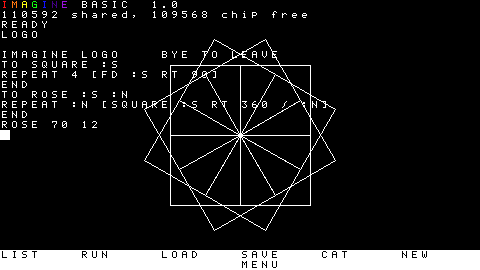
I've so far shoehorned in a Basic interpreter, a Basic compiler, a full screen editor, an assembler/disassembler, the above listed modules, and now Logo, and I'm just shy of 64k.
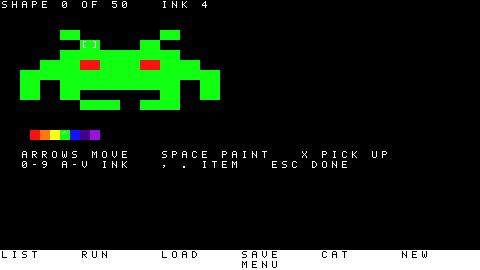
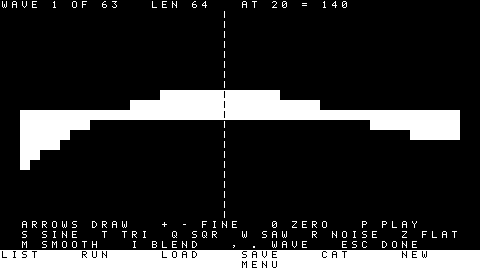
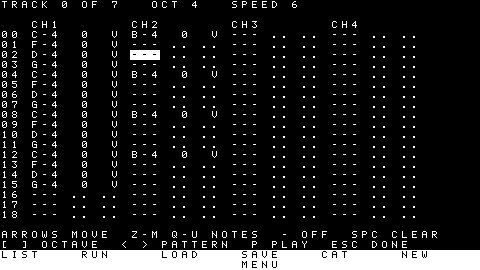
That second one needs a little explanation. That's not a sprite editor. That's a wavetable editor, custom-designing a sampled sound, that you can then feed into a 3MHz DSP while varying parameters to produce complex effects.
I did the math; it was genuinely possible in 1983 with some trickery; the Apple IIgs had it in 1986.
After shoving in a couple of forgotten display modes (512-colour half-res pixel switching and four-colour text) the ROM has hit 65,289 bytes. I think we can call it there.
Imagine BASIC 1.0, as it stands in the ROM: 104 keywords, 54 functions, 46 errors, 78 Forth words, 64 Logo words, 1,024 characters, 65,289 bytes of the 131,072 the ROM socket carries — which is five 32k×8 parts and a little logic, on a bus ten bits wide. Figures measured from the assembled image, not estimated, and every picture taken from the emulator at that build. Every colour on this page is a colour the machine can display.
- Well, crap. Ruby uses half-open intervals and Ada uses closed intervals.
No it doesn't!
The first big incompatibility in my compiler suite and it's not something I can resolve without breaking compatibility or programmers' minds.
No it doesn't!
Let me look up a reference on how other people resolved this p... It says that Ruby's default intervals are closed, exactly the same as Ada.
That's what I've been trying to tell you!
Musical Interlude
Disclaimer: An enigma and a mystery in meso-American history.
Posted by: Pixy Misa at
06:24 PM
| Comments (3)
| Add Comment
| Trackbacks (Suck)
Post contains 547 words, total size 5 kb.
1
I took a class where we had a module on Ada, lo these many years ago now. I thought it was interesting, but I didn't see how it would be useful for any kind of real product need. And of course there were no libraries. Has that changed?
Posted by: David Eastman at Tuesday, September 08 2026 02:46 AM (kpXig)
2
The DoD made DoD contractors use it back during the early nineties, and of course it is still in use. (I have heard that people dislike it.) I think that /maybe/ some aviation programming jobs hire Ada programmers without it being some sort of compatibility-with-federal-software thing.
Posted by: PatBuckman at Tuesday, September 08 2026 03:41 AM (6eVrQ)
3
I think Node.js proves the need: It is worse in every way imaginable. It gave us the left-pad incident. Even Java which is not built by idiots gave us Log4j which is impossible in the system I'm building - the capability model means that a logging module can do nothing but write log files - it can't even read them.
But what has really changed is the "no libraries" problem, in two ways: First, the language I'm building shares a common runtime and capability-based security model with the Ruby-styled version, so every library written for one is available to be linked into the other with zero impedance mismatch - same basic types, same capabilities, same design-by-contract model.
Second, with LLMs and that shared underlying model I can translate code written for one into idiomatic language for the other compiler and use that to test both compilers and the implementations for correctness.
It already has a pretty good suite of libraries: Common internet protocols - and uncommon ones too; dates and times in not just the Gregorian calendar but other major calendars as well; client libraries for many popular open-source databases; Web3 for blockchains; SSL and SSH; image processing; matrix and vector math and linear algebra; complex numbers, quaternions, and octonions; and a whole lot more.
But what has really changed is the "no libraries" problem, in two ways: First, the language I'm building shares a common runtime and capability-based security model with the Ruby-styled version, so every library written for one is available to be linked into the other with zero impedance mismatch - same basic types, same capabilities, same design-by-contract model.
Second, with LLMs and that shared underlying model I can translate code written for one into idiomatic language for the other compiler and use that to test both compilers and the implementations for correctness.
It already has a pretty good suite of libraries: Common internet protocols - and uncommon ones too; dates and times in not just the Gregorian calendar but other major calendars as well; client libraries for many popular open-source databases; Web3 for blockchains; SSL and SSH; image processing; matrix and vector math and linear algebra; complex numbers, quaternions, and octonions; and a whole lot more.
Posted by: Pixy Misa at Tuesday, September 08 2026 03:42 AM (PiXy!)
56kb generated in CPU 0.0307, elapsed 0.1772 seconds.
58 queries taking 0.1574 seconds, 372 records returned.
Powered by Minx 1.1.6c-pink.
58 queries taking 0.1574 seconds, 372 records returned.
Powered by Minx 1.1.6c-pink.