Wednesday, September 02

Three Doors Down From The Beast Edition
Tech News
- Gack.
I'm not convinced this chart is entirely accurate. I'm mostly convinced the algorithm producing it said this is fine at some point.
- Intel has launched Tiger Lake. (AnandTech)
Laptop parts only so far, and with a maximum of four cores, when AMD has been shipping eight core parts at the same TDP for months. But Intel has a small frequency advantage and a potentially larger IPC advantage and will likely run single-threaded tasks around 15% faster.
I do like how Intel claims "more than a generational increase in performance" when they're comparing with an architecture from 2015. Yes, well done, have a cookie.
The chips also have integrated USB 4 / Thunderbolt 4, which should mean rapid adoption of both, and PCIe 4.0. The chips feature Intel's new Xe graphics, which should be a big update, and support for LPDDR4X-4266. I was expecting LPDDR5 for some reason, but it's not mentioned anywhere.
One slight catch: This is purely an announcement. Not even review samples have been delivered so far.
- Asus has announced three new laptops based on Tiger Lake. (Tom's Hardware)
The most interesting one looks to be the Zenbook S, with a 13.9" 3300x2200 touchscreen. The other models include a 13.3" 4k OLED display, and a cheaper option with a 14" 1080p panel.
Screens aside they're all very similar; they use LPDDR4X memory so they're all limited to 16GB of RAM soldered to the motherboard.
A nice touch is that on all three models the trackpad is a small touchscreen itself. The Zenbook S, due to its narrower aspect ratio, lacks the Four Essential Keys, but they are present and accounted for on the other two models.
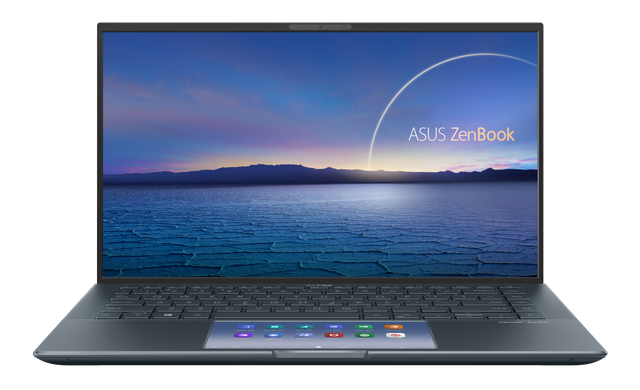
Shipping in October and November.
- Speaking of new hardware that looks great that you can't actually buy, Nvidia announced its RTX 3000 lineup. (AnandTech)
The RTX 3070 promises 50% more raw TFLOPS than the 2080 Ti at half the price. Nvidia don't claim that 50% more TFLOPS translates to 50% more performance, and the architecture has changed enough that we can't easily predict how it will run. But the half the price part certainly sounds good.
At this point they look like awesome cards, and we'll just have to wait a couple more weeks to find out how awesome.
- Ah shit, here we go again. (WCCFTech)
A stock Radeon 5700XT can earn about $5 per day mining whatevers with minimal effort. Good thing I wasn't planning on buying a new system any time soon.
- This is a demo of the Ys II opening credits running on the FM-77 AV. It looks more like a 16-bit game here than an 8-bit one.
Not sure exactly which model this ran on. All had similar CPUs (dual 1.6 MHz or 2 MHz 6809s) but they ranged from 64k to as much as 448k of RAM. But this isn't showing off the AV's signature 4096 colour mode, and the Ys wiki lists the platform as just the FM-7 which had 64k.
There are some compilation videos of FM-7 gameplay on YouTube, which show what the system really did - which in turn shows what is possible with something like the Imagine.
A couple of things stood out: First, the graphics used a limited number of colours, with dithering to smooth things out. I'm not sure if the original FM-7 could display more than 8 colours at once, though AV models increased that first to 4096 and later to 262,144.
Second, three voice FM-synthesis sound is not really that great. I'm planning at least five voices using wavetable synthesis, with something between 10 and 20 source LFOs.
By chaining the LFOs you can get all sorts of combinations of AM, FM, and PWM effects; it's kind of like the way the ANTIC chip could display impossible graphics modes by reprogramming the hardware on the fly.
Simple examples: Each voice has a sample table and a volume register. By updating the volume register on the fly, you can build an ADSR envelope in any shape you want - AM synthesis. A step register controls how fast the voice plays back the sample; by updating that register on the fly you can apply FM synthesis.
The computationally intensive part is applying the volume calculation, which is the only function that requires multiplication. Hence the realistic limit of perhaps five voices at full sample rate, with a bunch of other oscillators at lower sample rates providing modifiers.
Just need to figure out a simple and efficient way to handle stereo. A sensible approach of having one volume register and one balance register requires four multiplies per sample, which requires four times more hardware than mono. I'd like to figure out the trick an 80s audio engineer would use to handle that. Although very likely they'd just do it with an analog circuit, which would be cheating.
I think for the Imagine emulator I'm going to target an emulated system with 128k each of ROM, RAM, and VRAM, and a single 400k 3.5" floppy (with an emulator option to attach one or two external drives). That's a lot for 1983 (the year 3.5" drives first appeared), but not entirely unreasonable given that the FM-8 came out in 1981. 64k each of RAM and VRAM and some weird storage like Sinclair's Microdrive might be more period accurate, but I want this thing to be fun to program for, and at some point period accuracy turns into period pain.
The CPU will be the 10 bit design, emulated running at 3 MHz, with a free-run switch to go as fast as your real hardware can push it (which judging by my current code should be well over 100 MHz).
480x270 graphics in up to 32 colours from 512, 10 sprites, 5 sound voices as mentioned above. And a Microsoft Extended Colour Basic compatible compiler built into ROM.
The FM-7 and my Tandy Colour Computer both ran versions of Extended Colour Basic, since it was Microsoft's standard offering for the 6809. But I want to make it a compiler to make it easier to get good results.
I'm thinking of making the core engines of the video, audio, and I/O processors cut-down versions of the Imagine's 10-bit CPU, so they all have a common core set of assembler instructions, plus their own special extensions. The FM-7 could have three CPUs in 1982, so that's not as insane as it sounds, and would mean less weird stuff for programmers to learn.
Update: And map the chip registers into the quick page. That would mean the audio processor could have as many LFOs as would fit in 1k of virtual* registers - still only 5 output voices due to the multiplication bottleneck, but free reign on the modulators. That would be a lot of fun to tinker with. The TMS9900 took this approach to its registers back in '79, but didn't have enough fast static RAM for them, and as a result ran like a salted slug.
Update Two: I have a devious way to do this on a 6809-like chip as long as it has a moderately fast multiply instruction - say 10 to 15 cycles for a 10x10 multiply. The only problem is it would perform a lot of memory accesses; the sound chip would need its own RAM. Not a lot of it, but separate from the CPU.
* Virtual virtual registers, in fact.
- Oh, and I mentioned bubble memory yesterday. The FM-8 supported 128k bubble memory cartridges, which are something I could throw into this emulator. But a bit of poking the archives has largely dissuaded me. While the access time was good (40ms for the Intel 7110 chip) the data rate was just 100 kbps, slower than a double-density floppy's 200 kbps or so. And I found an ad for a 128k Apple bubble memory card from 1982 - it cost $895.
So floppies it is, I think. Imaginary ones. The best kind.
Disclaimer: Now I just need to write a self-hosting Basic compiler that targets an imaginary CPU with at least five variant implementations. What could possibly go wrong?
Posted by: Pixy Misa at
11:47 AM
| Comments (3)
| Add Comment
| Trackbacks (Suck)
Post contains 1365 words, total size 10 kb.
Tuesday, September 01
Flying Purple You-Know-What Edition
Tech News
- The RTX 3000 beans have been well and truly spilled. (Tom's Hardware)
Yes, the 3090 really does come with 24GB of DDR6X memory, moving at just short of 1TB per second. It's going to cost significantly more than my current PC, which also happens to have 24GB of RAM.
- This is the Sharp X1, from 1982.
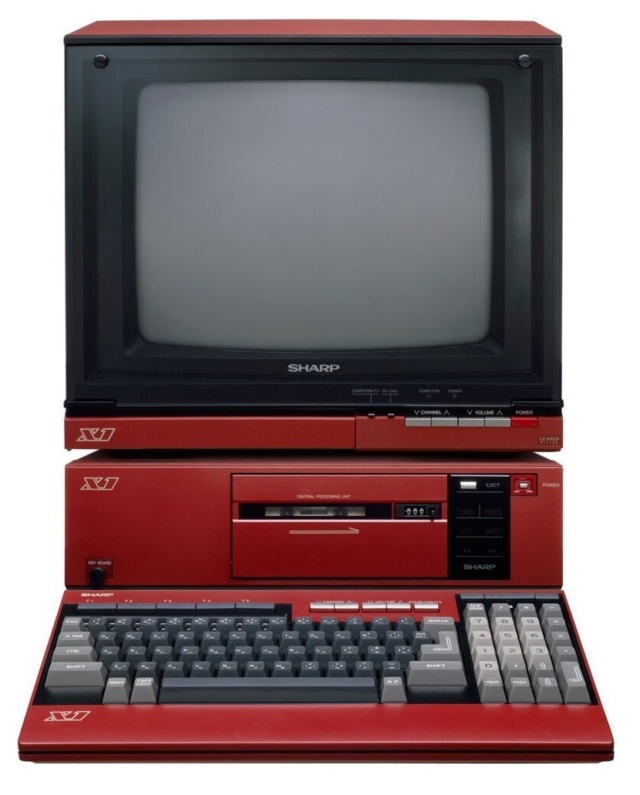
I was looking up details of the X68000 and saw this mentioned as its predecessor, so I dug around a bit more. While it's certainly striking in appearance, it's not remarkable inside: A 4MHz Z80, 64k of RAM, 6k of ROM, and 4k of video RAM. (Apparently that last was upgradeable, though I haven't found specifics.)
That 6k of ROM wasn't enough to hold a Basic interpreter, and it didn't try - you had to load it from tape. The reason it looks like a fancy cassette deck is because that's exactly what it was.
This guy actually has one - though not that model - with 48k of video RAM. (VintageCPU)
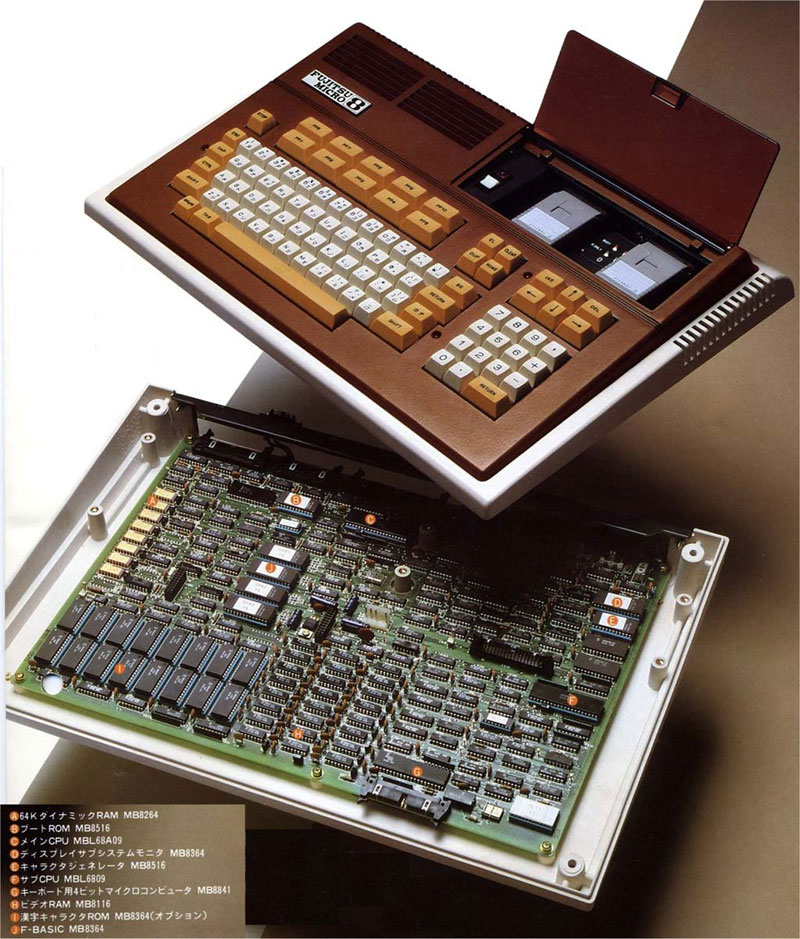
He also has not one but two X68000 models, and some computers I've never even heard of, like the Fujitsu FM New 7 from 1984, with 64k of RAM, 44k of ROM, 48k of video RAM, and two Motorola 6809 CPUs.
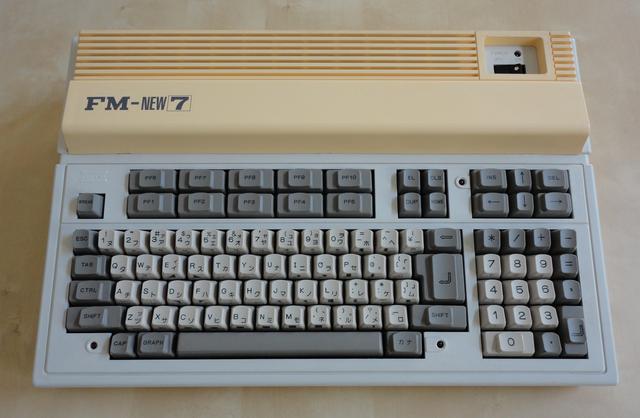
1984 is the year I smashed my piggy bank and bought my first computer - the Tandy Colour Computer was going at something like half-price at just A$250 for the advanced model. 16k each of ROM and RAM. Upgradeable to 64k in theory but I never had the money for that, after saving up for my own B&W TV set, and then a little thermal printer. And the editor/assembler ROM cartridge. And the joystick, which was rather nice.
Anyway, the FM New 7 was basically the Colour Computer squared and cubed. Instead of 256x192 2-colour graphics, it had 640x200 in 8 colours. It had a proper 3-voice sound chip. It could run OS-9, a Unix-like multi-tasking operating system that also ran on the CoCo, and is still around today. It had three expansion slots, somehow, including one that could take a Z80 for a total of three CPUs.
I saw several mentions of its densely-packed motherboard, and then found an actual photo.
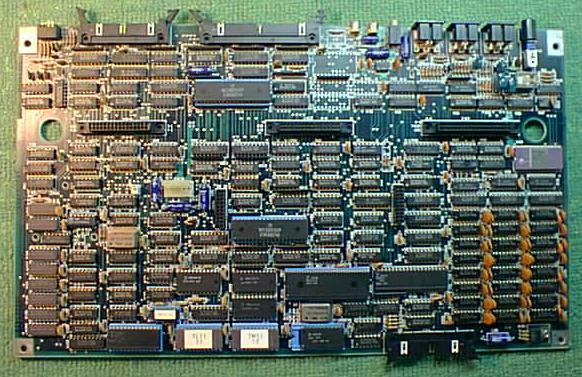
Yeah, that's a lot of chips. You can see the sockets for the three expansion cards. This thing must have run pretty warm when fully equipped.
This is amazingly close to what I've been thinking about for the Imagine, only it was real. Oh, and bank-switched, of course, so you only had about 32k of the 64k RAM available for your Basic code. And it was only a minor update over the original FM7 from 1982. And that was a cost-reduced version of the FM8 from 1981. (IPSJ Computer Museum)
Just look at this in all its early 80s glory.
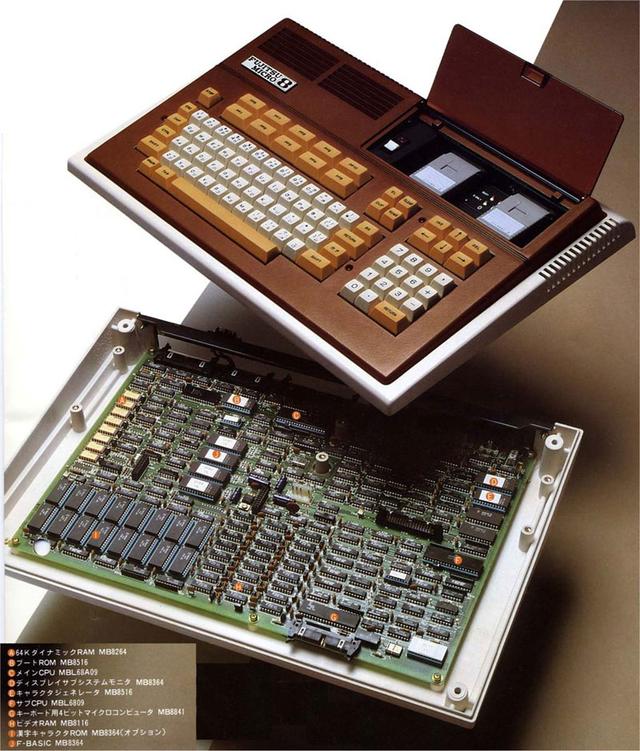
It was so 80s it even supported bubble memory.
The New7 was followed by the FM77 with up to 256k of RAM and a built-in 320k floppy drive, then by a whole family of FM77AV models.
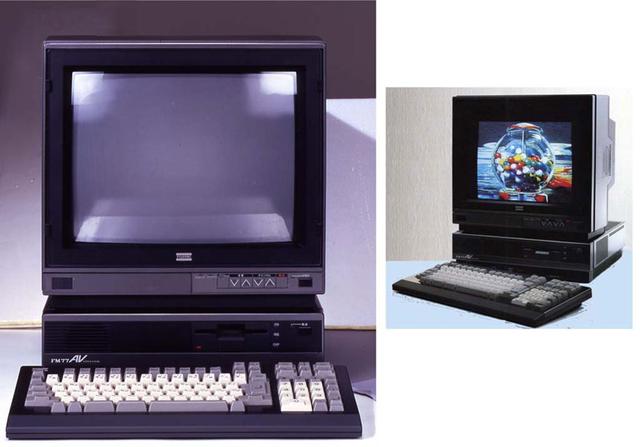
By the late 80s these were clearly eclipsed technically by the Amiga and Atari ST, not to mention Sharp's X68000. But - bank switching aside - my dream computer actually existed.
Posted by: Pixy Misa at
11:55 PM
| Comments (4)
| Add Comment
| Trackbacks (Suck)
Post contains 559 words, total size 5 kb.
Dodecahedrant Edition
Tech News
- There were at least two chips available in 1983 that could have handled my wavetable synthesis requirements for the Imagine: The TMS32010 which as we've noted cost around $500 a pop, and the 80286, which reduced the 70 cycle 8x8 multiply on the 8086 to 13 cycles. The 68000 could do a 16x16 multiply in a maximum of 70 cycles, so its worst case was twice as fast as an 8086's best case, but not quite fast enough.
Still, calculating the number of bits multiplied per second, I'd only need about 3% of a TMS32010 to handle 10-voice 10-bit wave synthesis. That's something that could have existed even if it didn't.
- Nice work if you can get it. (Quanta)
Mathematicians have been wondering for two thousand years if you can travel a straight path on a dodecahedron, starting at one vertex and returning to that starting point, without ever encountering another vertex.
On the other Platonic solids, it's long been known that you can't.
On the dodecahedron, turns out you can.
It's also the best die in D&D.
- Hacker News wasn't actually down. It's just that nobody could get there because BGP. (Cloudflare)
BGP considered harmful.
- Pinterest has decided it doesn't need a $90 million artist's rendering. (SFGate)
The company paid $90 million in penalties to terminate its lease agreement on a yet-to-be-completed office building.
Expect more of this. It will probably be ultimately good for everyone, except the SF city council.
- Apple is working on 5nm in-house GPU chips. (Tom's Hardware)
This is the undropped shoe of moving Mac to Arm. I have less than no interest in buying another Mac, now or after the transition, though I might need to at some point just to compile code for it.
After being delighted with my original Nexus 7 I bought an iPad as well. The retina screen was great, but the operating system and user interface were terrible and - more importantly - could not be fixed. Apple are doing the same to the Mac.
Not At All Tech News
- Even Jonathan Swift would have trouble with this one.
- The reason not to burn down cities is that it might help Trump.
- Ugh.
- Overhead, without any fuss, the stars were going out.
Posted by: Pixy Misa at
02:00 AM
| No Comments
| Add Comment
| Trackbacks (Suck)
Post contains 399 words, total size 4 kb.
Sunday, August 30
Dream A Twelve-Bit Dream Edition
Tech News
- Went out to the shops this evening. I self-isolated for a couple of weeks because I caught a cold - somehow - then for another week because I was feeling lazy, so it was time to emerge from my burrow.
Things were pretty normal. No shortages, except for the stuff that was half price, and no purchase limits. About a third of the people were wearing masks, though about a third of those were only sort-of wearing masks.
- I've nearly completed the programming model for the 10 bit Imagine and 12 bit Dream systems. The 10 bit model is positioned mid-way between the Z80 and the Z8000, with a dash of 6309 because the 6309 is really nice.
The 10 bit mode is a proper subset of the 20 bit mode, so there's no switching between the two; 10 bit code runs unaltered in 20 bit mode, and if you need to add a couple of 20 bit instructions here and there it just works.
The 12 bit system is a design I dreamed up a long time ago, half-way between the 6809 and the 68000. It has registers from A to Z, just because I could.
They're deliberately similar so I can easily target both with the same compiler. I haven't yet looked into 9, 11, or 13 bit designs. The 13 bit system will be as weird as logically possible, perhaps a cut-down iAPX 432 or Linn Rekursiv.
But that will be later.
I also need to figure out the rest of the hardware. I have a handle on the video controller, thanks to the existence of the Atari ANTIC chip and the NEC 7220. But I haven't yet figured out what exactly to do for sound. I want wavetable synthesis, because that's a real thing (the Apple IIgs had it) and purely digital, so I'm not faking an FM synth like the Commodore SID.
The first couple of commercially available DSPs in the early 80s (the NEC 7720 - just to confuse you - and the Intel 2920) didn't have hardware multiply and ran like snails. But a snail might be good enough here. Let's see: 10 voices, stereo, times a sample rate of whatever my imaginary HSYNC is... 18.75kHz, that's fine. 375,000 samples per second. So I would need to sustain one 10x10 multiply every eight cycles at 3MHz. That's not possible with software shift-and-add, but is probably feasible in hardware, if the hardware is feasible.
Oh, right, the 8086 had hardware multiply. How fast did that... Oh. A minimum of 70 cycles for an 8x8 multiply. Might need to rethink this part.
Update: The Z8000 was about twice as fast as the 8086, completing a 16x16 multiply (rather than 8x8) in 70 cycles.
The TMS32010 came out in 1983 and included a hardware multiplier that could complete a 16x16 multiply in 200ns - one cycle at 5MHz. Only problem is that it cost $500 at a time when an entire C64 cost $300.
By 1987 it was being used in toys, but in 1983 TI shipped a total of just 1000 units.
- When I was looking into doing this in hardware last year I considered using real components - 6809, Z80, and/or 6502. When looking up component availability for these 40-year-old chips, one name kept popping up: Rochester Electronics.
I'd never heard of them and wondered if they really had all this old stock. Turns out yeah, they kind of do. (Wikipedia)
They have over 27 billion components in stock, counting both complete devices and unpackaged dies. They also have a license to manufacture some old chips from the original designs, including the 6809.
- The Radeon RX 5300 sounds like it should be terrible but probably is just fine. (Tom's Hardware)
The 5700 is their mid-range gaming card - AMD don't really have a high-end gaming card in their current lineup, with Big Navi yet to make an appearance - with the 5600 in the low-mid range and the 5500 for entry-level gaming.
So two notches below entry-level means bad, right?
Maybe not. Seems to be a cost-reduced 5500, with 3GB GDDR6 RAM vs. 4GB, but the same 22 CUs. The current Ryzen 4000 APUs by comparison have 8 CUs, and they're just fine for light gaming, so this won't be bad at all.
Looks like it missed one mark, with a 100W TDP. At 75W it could run on PCIe slot power alone; instead it will need an additional 6-pin power lead.
- Samsung have officially announced their 980 Pro SSDs. (WCCFTech)
These are PCIe 4.0 models that really use the PCIe 4.0 bandwidth: Up to 7GB/s reads. up to 5GB/s writes, up to 1M IOPS.
Maximum capacity is only 1TB, which is kind of dumb. Are these MLC? Is that wh... Nope, TLC. Or as Samsung calls it, "3-bit MLC".
- Hacker News has fallen over. So no quirky little items for you today. (A lot of it makes its way to Reddit as well, but it's harder to find there.)
- Google wants to break the web. (Brave)
I mean, so do I most days, in the sense of throwing a virtual brick in its direction, but Google could actually screw things up in a major way.
This is about the big G's proposal of Web Bundles which are bundles of... Stuff.
The benefit of this is that one pre-compiled bundle can be downloaded faster than a hundred or two hundred pissy little files. The front page of Reddit, for example, makes 158 requests even with ads and trackers blocked.
The downside of this is that we already had this and it was called Flash.
Ratchet and Clank Extended Gameplay Trailer of the Day
This looks amazing. But also kind of dull. But then I'm not the target audience.
It does effectively show off the PS5 hardware. And the Xbox Series X is even more powerful, as far as graphics rendering goes.
Posted by: Pixy Misa at
10:10 PM
| Comments (10)
| Add Comment
| Trackbacks (Suck)
Post contains 1056 words, total size 8 kb.
 While I like that it bundles files, I hated its performance, its proprietary nature, and buggy implementation. Maybe you've been in the heat too long, and if that's the case, may I suggest
With Ten Bits You Get Egg Roll Edition
Tech News
- The Eiyuden Kickstarter is coming down to the wire.
With just over an hour to go, will they be able to make it to their... Hang on... 45th stretch goal?
Yeah, this one has been a success.
Update: They made it.
- Stop trying to make Arm servers a thing. They are not... Oh, you stopped. (Serve the Home)
Marvell has cancelled the general release of their Thunder X3 CPU. They'll continue to develop for custom and embedded servers, but they've given up trying to take on AMD for now.
- The Lenovo Yoga 7 Slim is a pretty good laptop. (Tom's Hardware)
Though Lenovo really only did two things:
1. Use an AMD chip.
2. Not fuck up too badly.
Apart from the Ryzen 4800U it's nothing special, but it mops the floor with its Intel-based competition. That may change when Tiger Lake arrives, but right now, AMD owns this space.
Two slight problems with it: First, it lacks the Four Essential Keys, and second, you can't buy it anyway.
- Two trillion dollars buys a whole lot of fuck you.
I can think of less stressful ways to earn a living than developing software for iOS. Juggling electric eels, for example.
- Apple pulled the plug on Fortnite. (Tech Crunch)
You can no longer get it from the App Store, and Epic's developer account has been zorched. Epic did get an injunction against Apple forbidding them from taking the same action against Unreal Engine for now.
- JetBrains also has a programmer font.
Those ligatures look like a really, really bad idea though. A ligature for ≥ sounds great until you realise that ≥ is its own distinct Unicode character, and you can no longer tell the difference between working code and line noise.
- A malloc Geiger counter. (GitHub)
That is a really cool idea. I'll put a hook into my virtual machine to do that sort of thing. A click every time a virtual interrupt happens, or a display list instruction is executed. With suitable prescaling you'll be able to hear how smoothly your code is running.
In fact, I might build the hook into the emulated machine rather than the emulator. What would the display list processor and the sound chip need to be able to do that? If the list processor could trigger interrupts on the other cores - that would do it, and be hugely useful generally. Yes.
- Objective-Rust. (Belkadan)
For when you want absolutely everyone to hate you.
Posted by: Pixy Misa at
01:13 AM
| Comments (1)
| Add Comment
| Trackbacks (Suck)
Post contains 441 words, total size 4 kb.
Saturday, August 29
Ambulatory Solifugid Edition
Tech News
- Is it reasonable to include a video controller co-processor like the Amiga's Copper in a 1983 design? As it happens, yes. (Wikipedia)
The same basic functionality was present in the Atari 400 and 800 as early as 1979, and gave the Atari 8-bit range (including the 5200) a lot of their flexibility.
And it's very easy to emulate those functions - as long as the video emulator respects its virtual registers, all the co-processor needs to do is write to them.
So you can set it up to switch from 32-colour mode to 512-colour mode to text mode to cell mode to Amiga-style HAM mode to Apple IIgs-style fill mode on a line-by-line basis.
Reading up on the Atari architecture I noticed a number of criticisms of Atari Basic. While the criticisms were not unfounded, the whole thing fit in an 8k ROM cartridge. "Hello, world." doesn't fit in 8k these days.
- Speaking of Elite - which we were - Elite Dangerous: Odyssey is due next year. (WCCFTech)
This is a tactical expansion that lets you land, leave your ship, and shoot the bad guys in person.
- Google is removing fediverse apps from the Play Store on the grounds that people are saying mean things on the internet. (Qoto)
Hacker News thread here.
- Apple is back to playing notice me, senpai with the DOJ. (ZDNet)
You are not permitted to work around the 30% cut Apple takes of every transaction.
You are also not permitted to mention the 30% cut Apple takes of every transaction.
- I forgot that this little beastie existed.
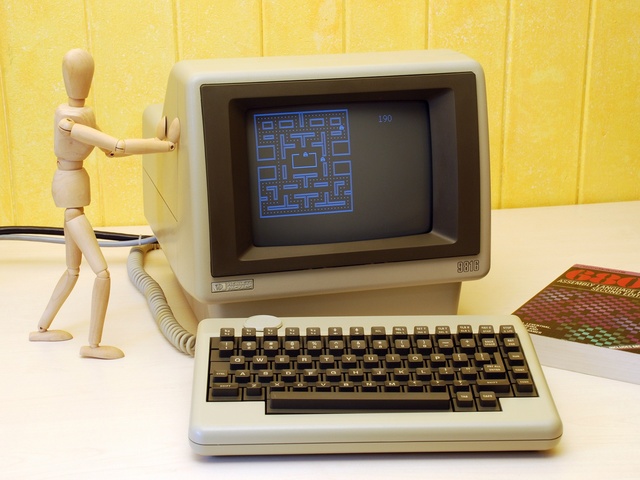
That is the HP Series 200 Model 16. Introduced in 1982, it's an 8MHz 68000-based system with 128k to 512k of RAM. It's usually seen with its dual 3.5" floppy expansion - one of the first products to use 3.5" floppies - but all the system logic is packed into that little monitor unit. The floppies reportedly ran at 600 RPM - twice as fast as normal - though I haven't found documentation to confirm that.
The screen is only 9", monochrome, and 400x300 (though text mode may have had a higher effective resolution), but that aside it was an impressive system for '82. It was not, of course, cheap, starting at around $4000.
Posted by: Pixy Misa at
02:39 AM
| Comments (4)
| Add Comment
| Trackbacks (Suck)
Post contains 397 words, total size 3 kb.
Friday, August 28
Where Oh Where Have My GAA-FETs Gone Edition
Tech News
- How much memory did home computers realistically have in 1983? The C64 came out in 1982, so that's one datapoint. The C128 came out in 1985.
But the Atari 1040ST came out in 1986. The Amiga 1000 in 1985 had 768K with the 256K expansion module. By the time I bought mine at the start of 1987 that shipped as standard but I don't know when that started.
If you look up the specs it will say that it came with 256K on board plus 256K on the expansion module, but that's not quite true. The OS ROMs weren't ready at launch, or indeed 18 months later, and the system came with an extra 256K of RAM instead so you could load what should have been there from a "Kickstart" disk. Installing the ROMs - kits became available in 1987 - turned that 256K into usable fast RAM.
I'm not sure if the A1000 ever shipped without that extra 256K of RAM, though the A500 shipped with 512K RAM and working ROMs.
So 128K in 1983 and 256K in 1984 is not entirely unreasonable. By mid-85 256K was something you could patch into hardware because the software wasn't ready.
Here's a handy collection of old Bytes on Archive.org.
I found the hard data I needed in - of all places - the New York Times. In June 1983 - dead centre on my imaginary time window - 256k DRAMs were sampling but not yet in production, and 64k chips were $4.50 each.
So 128k would run $72, and 256k $144. Plus another 25-50% if we're using 10-bit bytes, depending on whether we're using x1 or x4 chips. By comparison the C64 launched at $599 but the price came down pretty fast.
Since 256k chips were sampling in June '83, I can reasonably posit that the Imagine 1000 - which seems like as good a name as any for a fictitious 10-bit system - was designed from the start to be upgraded from 64k to 256k chips.
Using 3 4416 chips per bank to give 10 bits plus parity, 24 chips could provide the original system with 128k in total, while the Model B could come with half that number of chips but double the memory. And the Model A could be upgraded to a maximum of 512k with a simple chip swap.
That works. Why did no-one make this thing? Not that I had remotely that much money as a kid...
Update: In the March '83 issue of Byte there are adds for 64k memory upgrades (with parity) for $50, and the C64 could be found for $299 after rebate.
- TSMC's 3nm node will stick with FIN-FETs, with GAA pushed back to 2nm. (AnandTech)
I don't remember if TSMC had previously said that 3nm would be GAA, or just spoken of 3nm and GAA in the same breath and the rest was speculation.
Oh, and 2nm is coming.
- A sneak peek at Tiger Lake does show a single-threaded / IPC advantage over Zen 2. (Tom's Hardware)
Single-threaded performance is on the order of 5% better than a Ryzen 4300U, and since this particular Tiger ran at a lower clock speed, IPC is around 10% better. On multi-threaded workloads the 4-core/4-thread Ryzen 4300U was 45% faster than this 2-core/4-thread Tiger Lake chip, so AMD will retain a very comfortable multi-threaded lead even while we wait for Zen 3.
Intel is also expected to catch up on the graphics side with these new chips, but the leaked benchmarks don't say anything about that.
- Salesforce recorded a record quarter and immediately laid off 1000 staff. (Tech Crunch)
Uh. Timing is everything, guys.
- The share price of Fucking Elastic, makers of Fucking Elasticsearch, is at an all-time high. (WCCFTech)
No, I am not at all annoyed with the deliberately-introduced deficiencies of Fucking Elasticsearch. No, I didn't spend yesterday working around a broken-as-designed upgrade that wrecked application features that used to run just fine. Why do you ask?
- Milan will be up to 20% faster than Rome, sort of. (WCCFTech)
Rumours have been pretty consistent that Zen 3 has 10-15% better IPC than Zen 2, with the other 5-10% coming from minor clock speed improvements similar to the slight nudges we saw with the 3800XT.
It looks like L3 cache remains the same, but L2 cache has doubled, which would contribute to those IPC gains and help reduce contention on the new unified L3 cache.
Meanwhile Genoa is due by 2022 with "more than 64 cores", Zen 4, DDR5, and PCIe 5.0.
- Arwes makes your application look like it belongs in the 21st century. (Arwes.dev)
The 21st century as seen in the 1980s, anyway, which - looking at you, 2020 - was more optimistic than accurate.
- ArangoDB 3.7 supports JSON Schemas and other good stuff. (ZDNet)
It's a multi-model database - relational, object, document, graph, whatever - though currently pushing the graph features and its use case as a machine learning back-end, because that is the new hotness this month.
I've followed its progress but not actually used it, so can't say how well it really holds up.
Posted by: Pixy Misa at
01:43 AM
| No Comments
| Add Comment
| Trackbacks (Suck)
Post contains 887 words, total size 7 kb.
Wednesday, August 26
Itsy Bitsy Teeny Weeny Edition
Tech News
- Need 16 cores, 128GB of RAM, and dual built-in 10Gbit Ethernet ports on a mini-ITX board? ASRack Rock has you covered. (Serve the Home)
It's a server board, so rear panel I/O consists of the two 10GbE ports, two USB ports, VGA, and a separate 1GbE management port. The design is server-oriented in other ways as well: It's an X570 board with no chipset fan, so without server-style case fans it's gonna melt.
I'm not sure what the market is for mini-ITX server boards, since a rackmount case has plenty of room for ATX and even larger boards.
- Birds, honestly, kind of dumb. (Ars Technica)
Painting one blade of a wind turbine does seem to help them notice that there is a huge whirling death machine in their flight path, though, reducing impromptu chicken dinner incidents by more than 70%.
- Not beta, just broken. (The Register)
The new version of Firefox for Android is here.
People don't like it.
There's no option to go back to the old version.
Well, it's open source so I suppose building it yourself and side-loading it is sort of an option, though with the current limitations of copy-protection you'll probably be locked out of YouTube even if you do that.
- The upcoming RTX 3090 has been rumoured to cost $1400. Another rumour might explain that if it really does come with 24GB of GDDR6X RAM. (WCCFTech)
I remember being at a computer show years back and sitting down to watch a presentation. They had to reboot the computer running the projector and we saw that it had a video card with 24MB of RAM back in the days when 2MB was typical.
And 24MB is still enough to hold a 24-bit 4K framebuffer.
- The Trump administration is providing a billion dollars in funding for research into AI and quantum computing. (Tech Crunch)
If the Wuhan Bat Soup Death Plague doesn't kill us all, the Nanobot Apocalypse is sure to finish the job.
- The Asus Zenfone 7 has three rear cameras and three front cameras. (AnandTech)
In fact, it has three cameras. They go bziiip and pivot around.
- Asus also has a new 360Hz monitor if you're looking for a reason to buy that RTX 3090. (Tom's Hardware)
Only 1080p, of course. At 4K you're still limited to "only" 144Hz.
- The Microsoft Surface Duo is landing in reviewers' hands right now, and it looks really nice. It looks like a little notebook from back in the days when those were made of paper.
It's striking how much slimmer it is than the folding screen models. At just under 10mm folded up it's still slightly chunky for a 2020 device, but that's just 1mm thicker than my Nexus 7, which doesn't fold unless you really, really want it to.
- I've been looking up some details of 80s graphics chips to figure out what would be reasonable to implement in my imaginary system. Of course I know exactly what the Amiga could do since that was my primary computer for five or six years (an A1000 and then an A3000).
There was a Hitachi chip from the early 80s I was trying to find - turns out I was thinking of the HD63484 from 1984. (Computer.org)
That was followed in 1986 by Intel's 82786 which actually implemented my dual-bus architecture, and Texas Instruments' 34010, which was a graphics-oriented CPU.
Before all of those, in 1982, NEC introduced their uPD7220 (Hackaday)
Since that was a real chip that really existed (and was hugely successful), anything it could do is fair game for my emulator. Also the chip from the original MSX systems, which came out in 1983, right in my fictional time window.
Posted by: Pixy Misa at
11:47 PM
| No Comments
| Add Comment
| Trackbacks (Suck)
Post contains 691 words, total size 6 kb.
Tuesday, August 25
Multiple Dispatch Edition
Tech News
- Implemented a full set of instructions in the experimental VM in Nim - though three quarters of them are just dummies cut-and-pasted to fill out the case statement.
Performance dropped from 80 MIPS with one instruction implemented to 72 MIPS with 32 instructions. And that's without using the pragma options to optimise the case statement. Also using an array for the registers rather than individual variables, which simplifies the instruction dispatch but generates less efficient code.
So it seems to be safely past the point where PyPy had its nervous breakdown.
I might go with a default configuration of 128k each of system RAM and video RAM rather than worrying too much about squeezing things into 64k. The point of an imaginary 10-bit computer is, after all, that you can have more than 64k of linear address space.
I remember thinking about how nice it would be to have a whole 128k of RAM back then. Then of course I got an Amiga and skipped the entire late-8-bit generation.
- Nim imports all the methods of a module when you import a module.
That is, with Python, if you import the time module you get the time by callingtime.time()but with Nim it's justtime().
Python needs to do this because if you import a bunch of modules and they use the same name for some of the methods, it can't tell which version you mean.
Nim, though, uses multiple dispatch. If you have asavefunction that saves image data to a JPG file, and asavefunction that saves a record to a MongoDB database, they have completely different parameters and return types.
Python is dynamically typed so that's not a lot of help. Nim though is statically typed, so it knows which one you mean from the code that calls it.
This makes code less verbose, and makes using modules a more natural part of the language. I'll have to see how it works out in practice.
Also, JetBrains, makers of IntelliJ and PyCharm, are planning to release the first version of their official Nim plugin next month. I've been programming Crystal in VS Code and it is awful.
- TSMC's 5nm node is in production and 3nm is due in 2022. (AnandTech)
Which we basically knew already, but there is new data here as well. The figures given for transistor density - 1.8x going from 7nm to 5nm, and a further 1.7x from 5nm to 3nm - are for logic functions. SRAM scaling is significantly worse.
I originally suspected that the first use AMD would make of 5nm would be to implement even larger caches for their server parts, while another doubling of core counts would be further off. Instead it seems the reverse is more feasible.
That's not until next year at the earliest, anyway. Zen 3 is 7nm.
- And Zen 3+ may also be 7nm. (WCCFTech)
Or on the other hand it may not exist even as a box on a roadmap. Zen was followed by Zen+, but Zen 2 will be followed by Zen 3. People who know aren't talking and the people who are talking don't know.
- Is your Python application too stable? Don't have anything to keep you up at night? Why not write your configuration files in JavaScript? (GitHub)
You can thank me later.
Posted by: Pixy Misa at
11:34 PM
| No Comments
| Add Comment
| Trackbacks (Suck)
Post contains 571 words, total size 4 kb.
Four Frierens And A Funeral Edition
Tech News
- So I rewrote my VM testbench in Nim. With just a minimal framework in place - instruction decode, registers, memory, condition flags, and one instruction - I'm getting 80 MIPS. That's not amazing and I could certainly do better in C++ (and have in the past) but for these purposes it's just fine. The imaginary machine would be lucky to do 1 MIPS downhill with a tailwind, after all.
Nim is nice enough. I like Crystal somewhat more, but Nim is reasonably well-designed and seems reasonably well-implemented. You don't seem to be able to use ternary operators in compound expressions, though, so I'll have to figure out the proper way to evaluate the condition flags.
I did realise something when thinking about Elite on the BBC Micro. Although the imaginary hardware will implement hardware scrolling and sprites (the TI 99/4 had 32 sprites all the way back in 1979), that only helps for 2d games. For 3d what you need - apart from hardware line-drawing - is double-buffering.
And since I'm deliberately limiting the available memory to keep the system conceptually simple, it doesn't have enough memory to double-buffer at full resolution (a whopping 480x270).
The options as I see them are:
- "Well, that game came out in 1985, when the 256k upgrade was available."
- Weird cheats like the Apple IIgs fill mode to make 3d fast enough that you don't notice the flickering.
- Weird cheats like RLL-encoding of the pixel data to reduce memory requirements, which would be horrible to draw into but very effective when there are only a few colours in use.
- Weird cheats like chroma subsampling, which is period legitimate because both the Apple II and the ZX Spectrum did that. (The ZX Spectrum in a rather more organised way, colour in the Apple II's hi-res mode was just plain weird.) There are lots of ways to implement this, some of them easy to do in period hardware, most of them nasty to program for.
- Just use half-resolution - 240x270 isn't completely awful, and it can switch to full-resolution for the controls at the bottom which don't need to be fully re-rendered every frame.
- Drop the pixel clock from 12MHz to 8MHz, reducing the number of pixels per scan line to 320, and pack 5 4-bit pixels into each double-word read instead of 4 5-bit pixels, and finally letter-box it down to, um, oh, right, 256 lines. That's exactly 64k.
- The (imaginary) video chip has dual buses, originally so that the CPU could write directly to video RAM as it would with any other RAM, just with wait states inserted until the VRAM was free. But vice-versa, that allows the video controller to map system RAM for video functions, stealing cycles from the CPU. Still, using 480x270 5-bit mode with double buffering like this would leave 736 bytes free for your 10-bit version of Elite, so it might need to be applied in combination with some other trick.
(This is why I mentioned the video controller would have needed more than 40 pins if it had ever been made - two 10-bit data buses and two 8-bit multiplexed address buses is 36 pins before any control signals or even power and ground.)
- Every ten years, move everything that's done on the client to the server, and everything that's done on the server to the client, and everyone will think you're a genius. (Solovyov.net)
Server-side rendering, huh? Whatever will they think of next?
- We are continuing to work on a fix for this issue. (ZDNet)
I felt a disturbance in the Force, as if millions of children suddenly cried out with joy.
Zoom is down.
Given the nature of computers of that era it might be appropriate to implement all of these and never bother to test what happens if you set all the mode bits at once.
Posted by: Pixy Misa at
12:13 AM
| No Comments
| Add Comment
| Trackbacks (Suck)
Post contains 662 words, total size 5 kb.
55 queries taking 0.2789 seconds, 397 records returned.
Powered by Minx 1.1.6c-pink.