CAN I BE OF ASSISTANCE?
Shut it!
Wednesday, June 01

History Stood on its Head
This one sentence from that Newsweek article, out of all the nonsense and blather, has been niggling at me:
World War II was fought not just to defeat the Axis powers, but to make the world safe for the United Nations, the precursor to the World Trade Organization, the European Union and other international institutions that would strengthen weaker countries.
It's just so wrong, so irredeemably and inexcusably wrong.
Who were the Axis powers? Primarily, Germany, Italy and Japan. Spain was aligned with them; Hitler and Mussolini lent support to Franco in the Spanish Civil War. There were a number of other minor partners; Finland, for example, aligned itself with Germany because it saw Russia as a graver threat.
What was the war about? Germany, Italy and Japan wanted to secure more land and resources. Germany in Europe; Italy (as a lesser partner) would take the uninteresting bits of Europe (like Albania) and Africa; Japan would take eastern Asia and the Pacific. Look at this handy little map to see what they were up to.
Who opposed them? Well, Austria, Czechoslovakia and Poland, early targets during the war in Europe, simply didn't have the military strength to stop the Axis. Japan had already invaded Manchuria in 1931* and was expanding its presence there. There were three powers in the world that posed a significant threat: Britain, particularly the Royal Navy; Russia; and the United States.
The Molotov-Ribbentrop Pact (a non-aggression pact between Russia and Germany) dealt with Russia. Russia was ill-prepared for war at the time, having systematically destroyed the effectiveness of its own army through purges. Britain was more of a problem; the hope there was that it could be isolated until Germany and Italy had consolidated their position in Europe.
As for the United States, the chief plan was not to get them involved in the war. That may sound like a dreadful miscalculation, but in 1935 Congress had passed the Neutrality Act, which prohibited American support for any nation at war. The Act was renewed as late as 1939. American isolationism was in full flower in the 1930's, and the Axis powers were banking on it.
Then, of course, they screwed everything up. With a characteristic combination of paranoia and overconfidence, in 1941 Germany declared war on Russia and Japan declared war on the United States. The two sleeping giants were called into play in the war against the Axis, and after four more years of terrible bloodshed, the Axis was finally crushed.
World War II was entirely about the ambitions of the Axis powers. America wanted only to keep to itself; Britain had its Commonwealth; Russia was in no shape to do anything. Germany, Italy and Japan decided to take over the world. It sounds crazy. It was crazy. Something like 50 million people died for their ambitions.†
I wonder why Newsweek wants us to believe otherwise.
* The League of Nations, the UN of the day, did nothing.
† Estimates vary significantly in many cases.
Footnote: Britannica Online has this appalling bit of doublethink:
Axis Powers
Coalition headed by Germany, Italy, and Japan that opposed the Allied Powers in World War II.
Posted by: Pixy Misa at
08:40 PM
| Comments (7)
| Add Comment
| Trackbacks (Suck)
Post contains 534 words, total size 4 kb.
1
It's just so wrong, so irredeemably and inexcusably wrong.
I completely agree, but I like the way Wolfgang Pauli put it - "This paper is so bad it is not even wrong."
Posted by: allagash at Thursday, June 02 2005 10:01 AM (M5ajh)
2
Oooh! OOOh! I can do it, too! The Franco-Prussian War was fought to make the world safe for the personal computer... The 100 Years War was fought to make the world safe for elevators... The Crusades were fought to make the world safe for a Woman's Right to Choose...
See, it's easy! Pick any war, and then pick any concept
that didn't exist yet....
Posted by: Susie at Friday, June 03 2005 05:07 PM (V1YvO)
3
Umm, that handy little map-link was about the situation the war was in when the tides turned and Reich started losing. They were going for world domination...
Posted by: A Finn at Monday, June 06 2005 07:40 AM (lGolT)
4
Finland, for example, aligned itself with Germany because it saw Russia as a graver threat.
Nah, we had just had Winter War with Russia a year ago, so there was no way anyone would have fought on the Russian side. Germans had helped us in military conflicts, so of course we helped them when they asked us to.
Posted by: A Finn at Monday, June 06 2005 07:54 AM (lGolT)
5
Regarding the handy little map link, the US post office published a series of them on the in 1991 through 1995,
here.
Posted by: Pixy Misa at Monday, June 06 2005 07:59 AM (+S1Ft)
6
Nah, we had just had Winter War with Russia a year ago, so there was no way anyone would have fought on the Russian side.
True enough. That was a side-effect of the German-Russian non-aggression pact; it left Russia free to attack Finland. You could have fought both, but then you would have lost.
Germans had helped us in military conflicts, so of course we helped them when they asked us to.
Yeah. Only problem with that is that they were completely insane. Still, caught between Germany and Russia, you were pretty much screwed no matter what you did.
Posted by: Pixy Misa at Monday, June 06 2005 08:18 AM (+S1Ft)
7
We did actually fight 'em both, Russians first, then Germans when the bloodless retreating wasn't good enough for Russians demanding to see some Nazi corpses lying around Lapland.
Posted by: A Finn at Thursday, June 16 2005 05:44 PM (lGolT)
Hide Comments
| Add Comment
Just Say Non
Out of curiosity, I downloaded a copy of the proposed European Constitution (available
here in English; check
here for other languages or to read it online).
I skipped the table of contents (five pages) and the preamble and signatories (eight pages). The first two articles, Establishment of the Union and The Union's values are reasonable enough. The fun starts with article I-3.
1. The Union's aim is to promote peace, its values and the well-being of its peoples.
Well, okay. Peace is nice. But is that all you want to do? Promote peace? Hmm.
2. The Union shall offer its citizens an area of freedom, security and justice without internal frontiers, and an internal market where competition is free and undistorted.
Fine and laudable, this one. That's what I like to see. Not what some of the French political parties want to see (that part about the internal market), but I have no trouble with it. But then:
3. The Union shall work for the sustainable development of Europe based on balanced economic growth and price stability, a highly competitive social market economy, aiming at full employment and social progress, and a high level of protection and improvement of the quality of the environment. It shall promote scientific and technological advance.
Price stability? A
social market economy? Full employment? Social progress?
They're communists. And communism don't work.
Look, you just one paragraph ago said that you wanted an internal market where competition is free and undistorted. If you have that, you can't also have price stability, and you can't guarantee full employment. Those things just don't work together; they're antithetical.
[Update: Commenter Jojo points out that price stability is a term used to refer to zero or very low inflation (a good thing) rather than price controls (a bad thing) as I had assumed. This does somewhat deflate my anti-communist paranoia, but the document is still devotedly socialist and statist. Its prescription for every ill is more government.]
And who gets to define what social progress means?
It shall combat social exclusion and discrimination, and shall promote social justice and protection, equality between women and men, solidarity between generations and protection of the rights of the child.
What an awful jumble of weaselry. Are you trying to say "All men are created equal"? Because I think copyright has expired on the Declaration of Independence. A quick cut-and-paste and you're away.
It shall promote economic, social and territorial cohesion, and solidarity among Member States.
Well, okay. I mean, if you're going to have a Union, you have to have some sort of cohesion and solidarity going on.
It shall respect its rich cultural and linguistic diversity, and shall ensure that Europe's cultural heritage is safeguarded and enhanced.
Respect is fine. Safeguarding one's heritage is fine, I guess. Enhanced? What? How?
I'll skip some waffle. Article I-4 is a surprise: Short, sweet, right to the point:
Fundamental freedoms and non-discrimination
1. The free movement of persons, services, goods and capital, and freedom of establishment shall be guaranteed within and by the Union, in accordance with the Constitution.
2. Within the scope of the Constitution, and without prejudice to any of its specific provisions, any discrimination on grounds of nationality shall be prohibited.
Good stuff.† If it was mostly like that, I wouldn't mind the occasional outbreak of fluffy-bunnies, like:
The anthem of the Union shall be based on the ‘Ode to Joy’ from the Ninth Symphony by Ludwig van Beethoven.
The motto of the Union shall be: ‘United in diversity’.
United in adversity, eh? Oh, sorry.
But we're now on page 20... Of 485. Let's skip ahead a bit:
Article II-70
Freedom of thought, conscience and religion
1. Everyone has the right to freedom of thought, conscience and religion. This right includes freedom to change religion or belief and freedom, either alone or in community with others and in public or in private, to manifest religion or belief, in worship, teaching, practice and observance.
2. The right to conscientious objection is recognised, in accordance with the national laws governing the exercise of this right.
Article II-71
Freedom of expression and information
1. Everyone has the right to freedom of expression. This right shall include freedom to hold opinions and to receive and impart information and ideas without interference by public authority and regardless of frontiers.
2. The freedom and pluralism of the media shall be respected.
Article II-72
Freedom of assembly and of association
1. Everyone has the right to freedom of peaceful assembly and to freedom of association at all levels, in particular in political, trade union and civic matters, which implies the right of everyone to form and to join trade unions for the protection of his or her interests.
2. Political parties at Union level contribute to expressing the political will of the citizens of the Union.
Article II-73
Freedom of the arts and sciences
The arts and scientific research shall be free of constraint. Academic freedom shall be respected.
What a lot of blather. Yes, we have those rights. We don't need you to tell us that, because they are rights. Y'know, inalienable and stuff. What you mean to say is this:
Congress shall make no law respecting an establishment of religion, or prohibiting the free exercise thereof; or abridging the freedom of speech, or of the press; or the right of the people peaceably to assemble, and to petition the government for a redress of grievances.
Those five little words,
Congress shall make no law, they go to the heart of the problem. Governments make laws, it's what they do. They don't confer rights, because you
can't confer a right. You don't need to list universal rights in the constitution, but what you
can do is restrict the lawmaking powers of the government.
Skip skip
Article II-91
2. Every worker has the right to limitation of maximum working hours, to daily and weekly rest periods and to an annual period of paid leave.
Every worker? What if you're on an hourly contract? What if you're a freelancer paid on delivery?
Skip skip
Article III-312
3. Any Member State which, at a later stage, wishes to participate in the permanent structured cooperation shall notify its intention to the Council and to the Union Minister for Foreign Affairs.
The Council shall adopt a European decision confirming the participation of the Member State concerned which fulfils the criteria and makes the commitments referred to in Articles 1 and 2 of the Protocol on permanent structured cooperation. The Council shall act by a qualified majority after consulting the Union Minister for Foreign Affairs. Only members of the Council representing the participating Member States shall take part in the vote.
A qualified majority shall be defined as at least 55 % of the members of the Council representing the participating Member States, comprising at least 65 % of the population of these States.
A blocking minority must include at least the minimum number of Council members representing more than 35 % of the population of the participating Member States, plus one member, failing which the qualified majority shall be deemed attained.
4. If a participating Member State no longer fulfils the criteria or is no longer able to meet the commitments referred to in Articles 1 and 2 of the Protocol on permanent structured cooperation, the Council may adopt a European decision suspending the participation of the Member State concerned.
The Council shall act by a qualified majority. Only members of the Council representing the participating Member States, with the exception of the Member State in question, shall take part in the vote.
A qualified majority shall be defined as at least 55 % of the members of the Council representing the participating Member States, comprising at least 65 % of the population of these States.
A blocking minority must include at least the minimum number of Council members representing more than 35 % of the population of the participating Member States, plus one member, failing which the qualified majority shall be deemed attained.
And you thought that stuff about cloture and filibusters was bad.
Article IV-437
2. The Treaties on the Accession:
(a) of the Kingdom of Denmark, Ireland and the United Kingdom of Great Britain and Northern Ireland;
(b) of the Hellenic Republic;
(c) of the Kingdom of Spain and the Portuguese Republic;
(d) of the Republic of Austria, the Republic of Finland and the Kingdom of Sweden, and
(e) of the Czech Republic, the Republic of Estonia, the Republic of Cyprus, the Republic of Latvia, the Republic of Lithuania, the Republic of Hungary, the Republic of Malta, the Republic of Poland, the Republic of Slovenia and the Slovak Republic,
shall be repealed.
Nevertheless:
 the provisions of the Treaties referred to in points (a) to (d) and set out or referred to in the Protocol on the Treaties and Acts of Accession of the Kingdom of Denmark, Ireland and the United Kingdom of Great Britain and Northern Ireland, of the Hellenic Republic, of the Kingdom of Spain and the Portuguese Republic, and of the Republic of Austria, the Republic of Finland and the Kingdom of Sweden shall remain in force and their legal effects shall be preserved in accordance with that Protocol,
 the provisions of the Treaty referred to in point (e) and which are set out or referred to in the Protocol on the Treaty and Act of Accession of the Czech Republic, the Republic of Estonia, the Republic of Cyprus, the Republic of Latvia, the Republic of Lithuania, the Republic of Hungary, the Republic of Malta, the Republic of Poland, the Republic of Slovenia and the Slovak Republic shall remain in force and their legal effects shall be preserved in accordance with that Protocol.
You what?
It's not in fact utterly dire, as a plan for a European Union. That surprised me. It's a really lousy constitution, though. Its scope is too broad; it spends far too much time on what can, should, will or may be done instead of what the government cannot do.
Better than I expected, but the French got it right.*
But they're still communists. [Update: Still communists.]
*There, are you happy? I praised the output of a bunch of Eurocrats and the common sense of the French people in one sentence. Now my brain hurts.
† Actually, on second thoughts that's another case of rights inversion. Change it around to a "Congress shall make no law" clause, and you've got it. As it stands, it has the government guaranteeing a right, which is wrong.
Posted by: Pixy Misa at
07:15 AM
| Comments (11)
| Add Comment
| Trackbacks (Suck)
Post contains 1682 words, total size 11 kb.
1
The thing that really annoys me about all this is that you can bet your bottom dollar they are NOT going to consolidate their seats in the UN, WTO, or any other int'l body. Why should the EU get umpteen votes where the US gets one? They want the advantages of unity without the disadvantages.
Sorry, posted this in wrong thread first time.
Posted by: TallDave at Wednesday, June 01 2005 01:15 PM (9XE6n)
2
"Price stability? A social market economy? Full employment? Social progress?
They're communists. And communism don't work."
hehehe Excellent commentary and analysis...
And you're right, they could have been a heck of alot less verbose if they simply said "Congress shall make no law..." and emphasized what the govt. could NOT do, rather than blurring the boundaries and making the scope so broad as to unavoidably (at least I.M.H.O) invite interpretive trouble.
Posted by: kyer at Wednesday, June 01 2005 01:37 PM (oY0vI)
3
I don't understand why aiming for price stability is "communist"? They're saying they want economic growth without runaway inflation, which is the policy of pretty much every OECD country. I don't agree with this rhetoric that having a central government bank issuing currency is "communist"; it might not be a pure free market solution, but it's a far cry from actual communism.
Posted by: Jojo at Thursday, June 02 2005 01:40 AM (K7kS/)
4
There's a major difference between currency stability and price stability. Keeping inflation low is good economic policy. Keeping prices stable isn't. You can't keep prices stable with a free market, because a free market means that prices shift according to supply and demand. If you want to use government powers to maintain price stability, that's distorting the market, and that's what they just said they wouldn't do.
It's not just that that made me slap the "communist" label on them, though. A pledge of full employment in an election speech is unremarkable. In a
constitution it's a red flag... So to speak.
So too the "social market economy". So too the dedication to undefined social progress.
Call them socialist if you prefer, but really it's the same thing.
Posted by: Pixy Misa at Thursday, June 02 2005 01:51 AM (AIaDY)
5
Um, and I don't think I said anything about central banks. I'm a centrist, not a big-L libertarian. I have no problem with central banks.
Posted by: Pixy Misa at Thursday, June 02 2005 01:52 AM (AIaDY)
6
Europeans have long suffered from delusions of grandeur, so the wordy (yet empty) substanced constitution comes as no real surprise to me. Europe lost her real grandeur centuries ago and a stack of wordy documents cannot bring her back, until the people have a change of attitude.
Posted by: LASunsett at Thursday, June 02 2005 01:57 AM (6aOuQ)
7
Sorry, I (wrongly) assumed that you were against central banks because I assumed you were against the concept of monetary policy in general.
In any case, I think you misinterpret what they mean by "price stability". Price stability is a commonly used term to refer to low inflation; Alan Greenspan routinely uses the term in his speeches. It refers to the
general level of prices, not the prices of individual products. Check out Wikipedia:
http://en.wikipedia.org/wiki/Price_stability
I think you confuse "price stability" with price controls, such as price floors, ceilings and outright price fixing, which I agree would be a very bad thing and definitely warrant a "communist" label.
Posted by: Jojo at Thursday, June 02 2005 02:31 AM (K7kS/)
8
I wouldn't say "centuries ago". Europe had a lot going for it right through the 19th century, even with the various empires diminishing. Two world wars pretty much put paid to that.
You're basically right, though. Europe is living for the past, not for the future. That's evident in the consitution, with its emphasis on protecting Europe's grand heritage.
Posted by: Pixy Misa at Thursday, June 02 2005 02:31 AM (AIaDY)
9
It had a brief flash in the 19th century, but as Marxism began to take hold, it killed the entrepeneurial spirit that the early mercantilists produced.
Also, the continent was host to a lot of struggles, revolutions, and petty wars throughout the 18th and 19th centuries, as a prequel to the two world wars. That's not nearly the grandeur of the Bourbons and Hapsburgs.
Posted by: LASunsett at Thursday, June 02 2005 02:46 AM (6aOuQ)
10
Jojo - Thanks, it looks like you're right. I'll make a note of that in the post.
Posted by: Pixy Misa at Thursday, June 02 2005 06:21 AM (+S1Ft)
11
Good point LA, and that was a primary reason for US isolationism. No one wanted to get involved in another of those interminable European wars.
Posted by: TallDave at Thursday, June 02 2005 11:32 AM (9XE6n)
Hide Comments
| Add Comment
Newsweek, The Other Bit
This is some of what I didn't beat into a pulp the
previous time around. The subject today: Foreign Policy.
U.S. leaders have long believed military power and the American Dream went hand in hand.
They have?
I'm not saying you're wrong; after all, America was born out of a war against the British colonial administration. But I would like to see something more than a bald statement.
World War II was fought not just to defeat the Axis powers, but to make the world safe for the United Nations, the precursor to the World Trade Organization, the European Union and other international institutions that would strengthen weaker countries.
No it wasn't. Newsflash: The United Nations was formed
after the war. The United Nations had nothing whatsoever to do with the war, and the war had nothing to do with the United Nations.
The war was fought to defeat the Axis powers.
NATO and the Marshall Plan were the twin pillars upon which today's Europe were built.
Um, yes. True.
Today, Americans make the same presumption, confusing military might with right.
What?
If they're making the same presumption, are you saying that they were wrong to remove the Taliban and the Ba'athists? And the Nazis, and the Fascists in Italy, and the military rulers of Japan?
Following European criticisms of the Iraq war, the French became "surrender monkeys."
Say what? The line referring to the French as "Cheese-eating surrender monkeys" comes from a Simpsons episode of
1995. This opinion of the French dates to at least the Second World War, if not earlier.
The Germans were opportunistic ingrates.
They were?
The British (and the Poles) were America's lone allies.
And the Australians. And the Spanish, and the Dutch, and the Danes, and the Japanese, and the Koreans, and the Italians. But hardly more than a dozen other countries apart from those.
Unsurprisingly, many of those listening to Bush's Inaugural pledge last week to stand with those defying tyranny saw the glimmerings of an argument for invading Iran:
Well that makes sense, because the current rulers of Iran are certainly tyrants.
Washington has thus far shown more of an appetite for spreading ideals with the barrel of a gun than for namby-pamby hearts-and-minds campaigns.
Washington was all about namby-pamby hearts-and-minds campaigns, from the end of the Vietnam War right up until some time in 2001.
A former French minister muses that the United States is the last "Bismarckian power"â€â€the last country to believe that the pinpoint application of military power is the critical instrument of foreign policy.
Which is sheer nonsense.
America has been for the most part isolationist. It would, by and large, prefer to ignore the world. When the world insists on gaining its attention, however, the results are fairly predictable.
Contrast that to the European Unionâ€â€pioneering an approach based on civilian instruments like trade, foreign aid, peacekeeping, international monitoring and international law
Notable for its achievements in... Achievements in... Uh, wait, I'll get it...
or even China, whose economic clout has become its most effective diplomatic weapon.
Yes, because China is such a positive influence in the world.
The strongest tool for both is access to huge markets.
Because heaven forbid they should ever allow free trade.
No single policy has contributed as much to Western peace and security as the admission of 10 new countriesâ€â€to be followed by a half-dozen moreâ€â€to the European Union.
Well, except for the whole opposing the Communists so they wouldn't take over the
rest of Europe bit. I mean, without that there wouldn't be 16 "new" countries to admit to the European Union, but let's conveniently ignore that and imagine that Poland and Hungary and the Czech and Slovak Republics and all those places
just suddenly showed up on the map one day.In country after country, authoritarian nationalists were beaten back by democratic coalitions held together by the promise of joining Europe.
Um, what? You don't think the democratic coalitions might have been motivated by not wanting another five decades of oppression and economic ruin? No?
in the past month European leaders have taken a courageous decision to contemplate the membership of Turkey
A courageous decision to
contemplate the membership of Turkey. That's one heck of a dictionary you have there.
where the prospect of EU membership is helping to create the most stable democratic system in the Islamic world.
Out of what? Three? No, hang on, there are two new ones now, aren't there. I wonder how that happened.
When historians look back, they may see this policy as being the truly epochal event of our time, dwarfing in effectiveness the crude power of America.
Or, y'know, not.
The United States can take some satisfaction in this. After all, it is in large part the success of the mid-century American Dreamâ€â€spreading democracy, free markets, social mobility and multilateral cooperationâ€â€that has made possible the diversity of models we see today.
Translation: Thank the Americans that you're not all speaking German, Japanese or Russian.
This was enlightened statecraft of unparalleled generosity.
No it wasn't. It was a horrific war followed by a decades-long standoff.
But where does it leave us? Americans still invoke democratic idealism. We heard it in Bush's address, with his apocalyptic proclamation that "the survival of liberty in our land increasingly depends on the success of liberty in other lands."
Apocalyptic proclamation? Are you completely insane? What he said was that no country stands alone, and that our freedom is under threat while others suffer oppression. You have a problem with that?
But fewer and fewer people have the patience to listen.
And are impoverished thereby.
Headlines in the British press were almost contemptuous: DEFIANT BUSH DOES NOT MENTION THE WAR, HAVE I GOT NUKES FOR YOU and HIS SECOND-TERM MISSION: TO END TYRANNY ON EARTH.
"Almost" contemptuous? How about
openly contemptuous. I mean, ending tyranny on Earth, what a moron.
Has this administration learned nothing from Iraq, they asked?
What would you have us learn? That the French and the Russians cannot be trusted? Hey, we knew that.
The failure of the American Dream has only been highlighted by the country's foreign-policy failures, not caused by them.
Failure of the American Dream?
Last time I checked, America was still there.
Foreign-policy failures? What? Where?
The true danger is that Americans do not realize this, lost in the reveries of greatness, speechifying about liberty and freedom.
You
are completely insane.
Reveries of greatness? Reveries? America, who provided aid to tsunami victims by parking a spare carrier group off their shore, providing fresh water and medical care and flight facilities. That America?
You accuse America of "speechifying about liberty and freedom". America, that is right now this minute fighting to preserve freedom in Iraq and Afghanistan. America that still has troops defending Germany and Japan and South Korea.
Speechifying? No. That I'll leave to France and to the United Nations. President Bush doesn't speechify. He says what he is going to, and then he does it.
Posted by: Pixy Misa at
03:18 AM
| Comments (8)
| Add Comment
| Trackbacks (Suck)
Post contains 1126 words, total size 8 kb.
1
The thing that really annoys me about all this is that you can bet your bottom dollar they are NOT going to consolidate their seats in the UN, WTO, or any other int'l body. Why should the EU get umpteen votes where the US gets one? They want the advantages of unity without the disadvantages.
Posted by: TallDave at Wednesday, June 01 2005 01:14 PM (9XE6n)
2
Ignore above, wrong thread.
U.S. leaders have long believed military power and the American Dream went hand in hand.
It's so easy to forget, as this person apparently has, that America really had no military to speak of when we were dragged into WW II. That's why Imperial Japan and Nazi Germany thought we would be easy to defeat: in their eyes we were a weak, decadent nation.
Posted by: TallDave at Wednesday, June 01 2005 01:24 PM (9XE6n)
3
This has got to be one of the best fiskings (is that
right word?) I have ever read. This site is definately now a daily read.
Skip Christy
Lake Oswego, OR (USA)
Posted by: CNC at Wednesday, June 01 2005 01:31 PM (fpVgk)
4
The failure of the American Dream
lost in the reveries of greatness
Here's a useful link in combatting this kind of insanity.
http://www.cia.gov/cia/publications/factbook/rankorder/2004rank.html
speechifying about liberty and freedom
Now, what do all those countries in the top third or so have in common? They're rich and free because of America's commitment to liberty and freedom.
Posted by: TallDave at Wednesday, June 01 2005 01:34 PM (9XE6n)
5
Also interesting: Iraq
led the world in GDP growth in 2004. Now, they did start from a very low level, but 50% is still amazing growth, esp for a period that the media keep describing as getting worse.
But the real underreported economic story of the last 5 years is Eastern Europe. It seems like every country is growing at around 5%. China gets all the headlines, but China is still much poorer per capita and has serious weaknesses in financial infrastructure.
Posted by: TallDave at Wednesday, June 01 2005 01:41 PM (9XE6n)
6
You know, it's funny about that "Namby-pamby hearts-and-minds stuff"
As far back as i can remember, that comes from an old special forces slogan, "Grab 'em by the balls and their hearts and minds will follow."
I wonder if that's the first etymology.
Certainly the most straightforward (and via Occam, the correct) one.
Posted by: tommy at Wednesday, June 01 2005 09:27 PM (OJ+GI)
7
Heh. Maybe he meant "namby-pamby hearts-and-flowers". :)
Posted by: Pixy Misa at Wednesday, June 01 2005 09:58 PM (AIaDY)
8
It's so easy to forget, as this person apparently has, that America really had no military to speak of when we were dragged into WW II.
America was deeply isolationist in the 1930's. I've touched on this in my latest post. The Axis still planned more on avoiding conflict with America than defeating it, and they certainly weren't planning on what actually happened.
Posted by: Pixy Misa at Wednesday, June 01 2005 10:35 PM (AIaDY)
Hide Comments
| Add Comment
Readers Write
Tokyo Tom has asked some questions regarding my
recent Newsweek post that I think deserve a serious answer. He writes:
PM, do you see no serious issues in Andrew Moravcsik's "Dream on America" piece that merit discussion, or is everything a zero-sum game with you?
I think the article
is a serious issue. My problem with it is that it's not an examination of anti-Americanism but an
excercise in anti-Americanism. The former is worthwhile; the latter not.
I'm not sure what you are referring to with is everything a zero-sum game with you? The answer is no, but I don't know if that addresses your intended question.
I had thought it was a fairly accurate report of the perception of the declining importance and influence of the US in the world – so that what I found disappointing was not so much the content of the essay, but rather Newsweek’s decision not to run it in the US.
I have two main problems with this, which may not be easily distinguishable to those not familiar with my views.
The first is on anti-Americanism. It's a real issue, and it's worth examining, but it's uniformly irrational and counterfactual. That is, when it's based on facts, it's not logical, and when it's logical, it's not based on facts.
The second was with the article itself, which rather than simply examining anti-Americanism, is anti-American itself. And since anti-Americanism is irrational and counterfactual, that was reflected in the article.
Do you disagree as a factual matter either with (i) the perception abroad of a slipping US lead, coupled with rising disenchantment with/active opposition to US policies, especially post-9/11
I don't know that there's a perception abroad of a slipping US lead (in what?) There's certainly disenchantment with and opposition to US policies. That has been true for 229 years. What we see today is not the worst of it.
or (ii) the long decline in our relative economic dominance post-WWII as Asia, Europe and Latin America grow?
I would bloody well
hope that US economic dominance had declined since World War II.
World War II basically destroyed Europe and Japan, and caused massive destruction in Russia, China and elsewhere in Southeast Asia. America threw huge amounts of manpower and resources into winning the war, but its infrastructure was essentially undamaged. The war wiped away any lingering traces of the Great Depression in America, but it took a long time for Europe and Asia to rebuild.
What's more, America has 5% of the world's population, but accounts for over 20% of production. That this proportion is decreasing doesn't mean that the US is declining in real terms, just that the rest of the world is starting to get its act together.
What does the CIA Factbook or other statistics tell you about the changes in the share of the US in the global economy from 1935 to 2005? If these are indeed trends, is there a reason to be alarmed about either of them?
No. The trends are positive. The US economy continues to grow. The economies of some poorer countries are growing faster; that's good. Their growth will slow as they become richer and gains in productivity become harder to achieve. That happens to everyone.
Should we not be concerned with the antipathy towards the US in the rest of the world?
Frankly, I'm more interested in whether Fox will revive Futurama than the antipathy of the rest of the world to the US.
What I am dedicated to is getting good, reliable information out there, and a balance of opinion. That's a large part of the reason I run mu.nu. Too many countries live inside bubbles, I'd like to pop a few of them.
Do you see no trade-offs as the US spends huge sums (a signifcant amount borrowed against sharply cut federal revenues) on the military (including extravagant boondoggles such as missile defense, unsettling technologies such as tactical nukes, and nation-building in Iraq), while other countries are investing directly in productive industry?
No, of course there are no trade-offs. Everything's a win!
Sorry, my sarcasm got the better of me there.
In order:
The US military allowed intervention in Afghanistan and Iraq, with a standing, peace-time, all-volunteer military, with great success and minimal losses. That's a good thing.
Missile defense is hardly a boondoggle with nations like Iran and North Korea looking to lob nukes at anyone they dislike. You'd be foolish not to be investigating missile defense at this point.
Unsettling technologies such as tactical nukes? You have something of a point there. Nuclear weapons are taboo; their use is all but unthinkable. Tactical nukes would weaken that taboo, and if your number one priority is preventing the use of nuclear weapons, that would be a bad thing. I think, though, that this has to be balanced against the intended purpose of tactical nukes - bunker busters to destroy ABC (atomic/biological/chemical) warfare facilities in rogue states.
Other countries are investing in productive industry? Why, so is America. At the same time as acting as the world's policeman and planning a moonbase and a manned expedition to Mars and a billion and one other things.
It is more than simply disappointing that our invasion of Iraq has drawn no where near the level of burden-sharing that the US was able to secure in the cases of the first Gulf War and the action against Serbia.
Right. But we need to examine the reasons for this. The liberation of Iraq was the right thing to do. Opposing it was wrong. We want to know
why people opposed it. Most of the reasons given, however, are irrational and counterfactual.
Reflexive self-justification and denial are understandable, but do not help us to deal with real problems.
Which is why I don't engage in such things.
Just so you know, Tom, I'm Australian.
The US is facing a critical task to stem and reverse the serious decline in relative power that the US is now experiencing as investment and power flow to the growing economies of Asia, Europe and Latin America
Why?
Why is this a critical task?
as the Newsweek article points out so well.
I can't see that the Newsweek article pointed out any such thing.
Our place in the world will soon be much diminished, and we refuse to get our own house in order - enormous budget and trade deficits, declining technical and science skills, a frayed social support network, accelerating disparities in wealth (see David Brooke`s op-ed in today`s Times), you name it.
The budget and trade deficits are a real, if long-term problem.
I'm not at all convinced there are declining technical and science skills. I don't see American research and engineering suffering at all.
I don't see a particularly frayed social support network either. And I don't see wealth disparities as a problem, as long as both rich and poor are improving their lot, and as long as there is opportunity for improvement, something America has always been very good at.
We face a growing dependence on imported oil but have no cogent energy policy (which should include pricing to cover defense and environmental costs).
America should be building more nuclear power plants, including breeder reactors. The present administration seems inclined to push in that direction, which is a good thing.
What a mess we are handing off to our children, who will have to foot the bills and the poorer America that we seem to be willing to settle for!
And again, the present administration seems willing to address issues such as the unsustainable nature of the Social Security system.
Many global issues cry out for US leadership, but we refuse to accept that mantle in favor of unilateralism.
Many global issues do indeed cry out for US leadership, but what nations are willing to accept that leadership? Unilateralism (the old go-it-almost-alone route) is not something America chose; it was imposed by the intransigence of other nations.
The Adminstration, Congress and big business are fiddling while Rome burns (see Tom Friedman’s op-ed in Friday’s Times (http://www.nytimes.com/2005/05/25/opinion/25friedman.html?th&emc=th). It is a real disappointment that the Republican party is not making a serious attempt to revitalize and strengthen the US economy, but is instead sapping our competitiveness with outrageously irresponsible budget deficits (in which the roles of tax cuts and our grossly expanded and unfunded military budget must be acknowledged).
I started reading the Thomas Friedman piece. He begins by criticisng companies for not demanding enough government money (in various forms). That's not the solution we're looking for.
In fact, I'm not sure what Friedman is proposing. Subsidies for industry? Protectionism? No, he seems to be pushing for trade agreements. But some sort of government intervention. What? And why? And how is that supposed to help? He seems to think that the government should shoulder the burden of GM's health insurance. Why? Why not let GM cut its health care plan, or failing that, go broke?
Budget deficits are a problem. They're hardly uncommon during wars, but long term, they need to be fixed. Expanding social programs and subsidising business isn't the road to a balanced budget.
I'll note that Australia has been running budget surpluses for years, to the point that government debt is expected to be fully paid by next year. On the other hand, we don't have anything like America's military expenses - even proportionally - because America is shouldering that burden.
While responsible for what still is the largest economy and most important country in the world, the Administration seems to be doing all it can to make sure that voters don't hear any bad news.
Um, in what way?
The administration doesn't run the media, you know.
While there may well be room to criticize the Newsweek piece, it is unfortunate that the blog discussion has ignored the real substantive issues raised by the article, but focussed instead on perceived slights to the flag and the “motives†of Newsweek.
I don't see any substantive issues raised by the Newsweek article, I'm afraid.
While I fault Newsweek for selling America short by deciding not to run the piece in the US, sadly this decision seems to reflect ironically one point of the article - that in fact most of Newsweek US readers would rather hear about the Oscars, than to be forced to face unpleasant facts about our declining global position.
The problem is the Newsweek article doesn't address the declining global position of the US, if such a thing is happening in any meaningful way. Rather, it addresses and engages in antipathy towards the US. That's not productive, not in any way.
But then I suppose it is too much to expect, if our Administration, Congress and business leaders are not willing to talk about serious issues, that our press would show it has real balls.
Once again, the Newsweek piece does not raise serious issues.
It's not a question of balls, it's a question of relevance.
Can we have a real discussion of our slipping economic position, or do we all find it easier to shoot the messenger? I look forward to some enlightenment.
We can have a real discussion, sure. But first, you have to establish what you mean by "our slipping economic position" in the context of an economy that is growing faster than almost any other first-world nation. That the global economy grew by 4.9% in 2004 compared to America's 4.4% is cause for celebration, not despondency.
Posted by: Pixy Misa at
12:21 AM
| Comments (12)
| Add Comment
| Trackbacks (Suck)
Post contains 1878 words, total size 12 kb.
1
Great post. It's surprising how few people understand that a relative decline in comparative rate of growth is not a decline in absolute terms, and that because economics is a positive-sum game, better growth in other countries benefits us too (new markets).
What I am dedicated to is getting good, reliable information out there, and a balance of opinion. That's a large part of the reason I run mu.nu. Too many countries live inside bubbles, I'd like to pop a few of them.
Too true. Something that is
never mentioned in these articles that bemoan how "unpopular" America has become is that 90% of anti-Americanism is firmly rooted in ignorance, and the other 10% is counterfactual Chomskyite sophistry. I noted an especially virulent and telling example of this phenomenon
here.
Posted by: TallDave at Wednesday, June 01 2005 12:07 PM (9XE6n)
2
PM: Many thanks for your responses to my questions; I have honored them with a little more research. I'd appreciate your further views.
I'm not quite sure how to format my follow-up to your comments, so forgive me if this is rather unwieldy. I have bracketed my counter-comments and started them with TT.
May 31, 2005
Readers Write
Tokyo Tom has asked some questions regarding my recent Newsweek post that I think deserve a serious answer. He writes:
PM, do you see no serious issues in Andrew Moravcsik's "Dream on America" piece that merit discussion, or is everything a zero-sum game with you?
PM: I think the article is a serious issue. My problem with it is that it's not an examination of anti-Americanism but an excercise in anti-Americanism. The former is worthwhile; the latter not.
I'm not sure what you are referring to with is everything a zero-sum game with you? The answer is no, but I don't know if that addresses your intended question.
[TT: PM, I was concerned that your primary focus might be on defending your mental “map†of reality; in other words, “winningâ€Â. I appreciate the time you spent responding to my earlier post, but it seems to me that you have spent more time avoiding or downplaying inconvenient facts than seriously addressing them.
Yes, Andrew Moravcsik is in part expressing his opinion, but your labelling it as “anti-American†deliberately turns attention away from the underlying messages, even though you grudgingly acknowledge the gist of them in the rest of your responses. I think these messages should hardly be news:
l that while America still harbors an image of itself as a beacon to the world, that image is viewed as quite a bit tarnished outside the US, in part because of perceived serious deficiencies with the “American Dreamâ€Â,
2 that while America is “lost in the reveries of greatness, speechifying about liberty and freedom,†others see an “imperial America relentlessly pursuing its narrow national interests,†with “the anti-Bushism of the president's first term is giving way to a more general anti-Americanism,â€Â
3 that the relative economic importance of the US in the world is declining, along with the willingness of others to follow the foreign policy “lead†of the US,
4 that while the US remains for now the sole military superpower, our willingness to use that “hard†military power unilaterally has contributed to a rapid decline in our soft influence over the rest of the world, so much so that a strikingly large percentage of our traditional allies, who are more inclined to multilateralism, see the US as a threat to world peace, and, finally
5 that Americans in general are unaware of the changes in how the rest of the world regards the US.
When Moravcsik calls this situation dangerous, I believe he was writing for a US audience, as I understand he was also surprised that Newsweek did not run his piece in the US. While I have a slightly different view from Tokyo, I believe that it is important for the US to grapple with these messages, which relate to clear and significant changes in the international order, even if we may take issue with the “fairness†of the perceptions of our traditional allies, China, the Muslim world or Latin America.
William Greider recently noted, “American leadership has … become increasingly delusionalâ€â€I mean that literallyâ€â€and blind to the adverse balance of power accumulating against it.]
I had thought it was a fairly accurate report of the perception of the declining importance and influence of the US in the world – so that what I found disappointing was not so much the content of the essay, but rather Newsweek’s decision not to run it in the US.
I have two main problems with this, which may not be easily distinguishable to those not familiar with my views.
The first is on anti-Americanism. It's a real issue, and it's worth examining, but it's uniformly irrational and counterfactual. That is, when it's based on facts, it's not logical, and when it's logical, it's not based on facts.
[TT: If anti-Americanism is a real issue worth examining, why don’t you do so?]
The second was with the article itself, which rather than simply examining anti-Americanism, is anti-American itself. And since anti-Americanism is irrational and counterfactual, that was reflected in the article.
[TT: Clearly Moravcsik’s article reports on views from abroad, which merit discussion. I would hope you would acknowledge that the fact of reporting on unfavorable views from abroad is not anti-American.
The article also reflects an own opinion that perhaps some of the views of those outside the US may be correct, that American society and foreign policy are in fact not working so well, and that there are aspects of other societies that compare favorably to the US. Well, I would have to say that IMHO, there are many things wrong with the US, and I would suppose that you and any of your readers could critique various aspects of the US as well. I might be an idiot, and you might disagree with Moravcsik’s views, but that doesn’t make either you, me or Moravcsik anti-American. So let’s stick to the issues.]
Do you disagree as a factual matter either with (i) the perception abroad of a slipping US lead, coupled with rising disenchantment with/active opposition to US policies, especially post-9/11
I don't know that there's a perception abroad of a slipping US lead (in what?) There's certainly disenchantment with and opposition to US policies. That has been true for 229 years. What we see today is not the worst of it.
[TT: Okay, so we have some grudging acceptance of the message. I would think you would have to acknowledge that the “disenchantment with and opposition to US policies†have risen very dramatically since GWB first took office. It is precisely because we can’t unilaterally force our will on the rest of the world that we need to be concerned about our declining ability to persuade others to work with us. Why is this not worth talking about?
As to what we’re losing the lead in, I think you could probably list quite a few items. A few that come to mind for me are economic predominance, science & technology, private R&D, patent applications, and sophisticated manufacturing.
Moravcsik, however, makes the general point that much of the rest of the world no longer looks up to the US and has lost faith in “the American modelâ€â€political, economic, diplomaticâ€Â. Among others, Moravcsik indicates that the US is not seen as a leader on issues such as privacy protection, social protections, social mobility, opportunity and inequality, incarceration rates, child-poverty rates, and that the US seems to have turned away from multilateral cooperation (where we once led the world on issues such as global warming, control of land mines and small arms, and international courts).
He gets support on this perspective from many others; see this recent article by Joe Stiglitz: http://www.tompaine.com/articles/20050406/democracy_starts_at_home.php.
or (ii) the long decline in our relative economic dominance post-WWII as Asia, Europe and Latin America grow?]
I would bloody well hope that US economic dominance had declined since World War II.
World War II basically destroyed Europe and Japan, and caused massive destruction in Russia, China and elsewhere in Southeast Asia. America threw huge amounts of manpower and resources into winning the war, but its infrastructure was essentially undamaged. The war wiped away any lingering traces of the Great Depression in America, but it took a long time for Europe and Asia to rebuild.
What's more, America has 5% of the world's population, but accounts for over 20% of production. That this proportion is decreasing doesn't mean that the US is declining in real terms, just that the rest of the world is starting to get its act together.
[TT: Why do you dodge the issue and ramifications of the long decline in US economic dominance? Even while our economy has continued to grow, the fact that the rest of the world has been catching up means that the US has steadily less influence. The rest of the world no longer see itself beholden to us, in the way it once was. In particular, the collapse of the USSR as a superpower has made the US nuclear deterrent and NATO less relevant in Europe; Russian is perceived as much less of a threat, so we see a tendency for Europe to define itself in opposition to the US. We have little leverage over China, India and Brazil, which are all growing in economic strength and influence. In fact, the US is now competing with China for energy and mineral resources all over the world, including Canada and Latin America.
What does the CIA Factbook or other statistics tell you about the changes in the share of the US in the global economy from 1935 to 2005? If these are indeed trends, is there a reason to be alarmed about either of them?]
No. The trends are positive. The US economy continues to grow. The economies of some poorer countries are growing faster; that's good. Their growth will slow as they become richer and gains in productivity become harder to achieve. That happens to everyone.
[TT: Do you really think everything is so peachy keen? The consequence of these changes is the US losing power and influence, and even though we remain for the time being the sole superpower we can no longer as easily bear all of the expense and responsibilities that role entails.
Our focus on the military undermines our long-term economic strength, and our insistence on using military force to achieve foreign policy objectives is in defiance of our actual capabilities and has the perverse effect of making our goals more difficult to achieve.
Should we not be concerned with the antipathy towards the US in the rest of the world?]
Frankly, I'm more interested in whether Fox will revive Futurama than the antipathy of the rest of the world to the US.
[TT: I’m with you on Futurama; but have learned to live without it after moving to Tokyo (no Fox).
I understand where you’re coming from – I rather not care what anyone else thinks about us either. But the truth is that not only does it matter, but matters greatly, what the rest of the world thinks of the US. We cannot unilaterally impose democracy at the point of the gun throughout the rest of the world. We have to work with others to realize our agenda. I suppose that it is in recognition of this reality that the Bush administration calls the autocrats of Russia, Pakistan, Uzbekistan and the Sudan our “friendsâ€Â.]
What I am dedicated to is getting good, reliable information out there, and a balance of opinion. That's a large part of the reason I run mu.nu. Too many countries live inside bubbles, I'd like to pop a few of them.
[TT: Your professed goals are right on - sounds like you’d like to write articles like Moravcsik’s! I agree with you about bubbles, but the sad fact is that everywhere it makes people feel good to live inside their own bubbles, and they would really much rather that others do not do them the favor of popping them.
Do you see no trade-offs as the US spends huge sums (a significant amount borrowed against sharply cut federal revenues) on the military (including extravagant boondoggles such as missile defense, unsettling technologies such as tactical nukes, and nation-building in Iraq), while other countries are investing directly in productive industry?]
No, of course there are no trade-offs. Everything's a win!
Sorry, my sarcasm got the better of me there.
In order:
The US military allowed intervention in Afghanistan and Iraq, with a standing, peace-time, all-volunteer military, with great success and minimal losses. That's a good thing.
Missile defense is hardly a boondoggle with nations like Iran and North Korea looking to lob nukes at anyone they dislike. You'd be foolish not to be investigating missile defense at this point.
Unsettling technologies such as tactical nukes? You have something of a point there. Nuclear weapons are taboo; their use is all but unthinkable. Tactical nukes would weaken that taboo, and if your number one priority is preventing the use of nuclear weapons, that would be a bad thing. I think, though, that this has to be balanced against the intended purpose of tactical nukes - bunker busters to destroy ABC (atomic/biological/chemical) warfare facilities in rogue states.
Other countries are investing in productive industry? Why, so is America. At the same time as acting as the world's policeman and planning a moonbase and a manned expedition to Mars and a billion and one other things.
[TT: Before addressing your individual points, let me point out that unfortunately there is no free lunch, but instead that little matter of the tradeoffs ... .
It was a great help to the Japanese and Europeans in catching up with us that they could spend much less of their GNP on defense, thanks to the US. However, our enormous defense expenditures continue to be a significant drag on investment in productive industry, and to undercut our competitive position. Aside from some Keynesian pump-priming, defense expenditures generally just don’t provide the same bang as a buck spend on manufacturing-related R&D. There is a real cost to military spending with respect to our future competitiveness.
As for Iraq, we have created a hydra-headed monster. What was the wisdom in the Iraq adventure? While Saddam had nothing to do with Al Qaeda, we have certainly been heaping fuel onto bin Laden’s terror agenda. Further, as Paul Craig Roberts recently noted, “the US has proven to the world that it cannot occupy Baghdad, much less Iraq.†A few thousand insurgents have succeeded in tying down 8 US divisions, and the bulk of the US force in Iraq is engaged in protecting its own bases and supply lines. As Robert F. Ellsworth, vice chairman of the Nixon Center and Dimitri K. Simes, president of the center and co-publisher of the journal. In an editorial headlined 'Realism's Shining Morality,' they wrote: 'Overzealousness in the cause of democracy (along with a corresponding underestimation of the costs and dangers) has led to a dangerous overstretch in Iraq,'
While missile defense may sound good in theory, in practice it IS a boondoggle that provides no practical value against North Korea, and a huge waste of funds that could be better deployed to protect America against terror (see Fred Kaplan’s ongoing series of articles in Slate). Missile defense consumed $10.7 billion of the 2004 military budget triple the 2003 amount and far more than any other weapon system. About $80 billion has been spent on it so far and another $80 billion is scheduled to be spent before the decade is out. It is nowhere near to working; although a number of missile interceptors have been “deployedâ€Â, in the last test we didn’t even get a launch, and the system can easily be beaten if the offensive missiles are MIRVed, decoyed, or simply outnumber the much more expensive interceptors. Former Pentagon testing chief Phillip Coyle has ripped the program: http://www.defensetech.org/archives/001068.html.
I see you’re with me on tactical nukes; this is a real concern. Although President Bush is trying to persuade "rogue regimes" and other nations to forgo their nuclear ambitions, the Administration is shoveling money to U.S. nuclear weapons laboratories at more than $6 billion per year – 50% more in real dollars than the average when the Soviet Union existed and the Cold War still raged. What justifies this expense, in the face of other priorities? The US has also refused to comply with our NPT treaty obligation to sign the Comprehensive Test Ban Treaty, and has announced a preemptive strike policy. These policies appear counterproductive; clearly the North Koreans and possibly the Iranians are much further down the road toward possession of nuclear weapons than four years ago (neither country, by the way, is in violation of the NPT), and Muslim Pakistan, which has nukes, has become increasingly fundamentalist. At the same time, the Administration has underfunded the program designed to lock-down the thousands of poorly controlled nuclear warheads scattered across Russia, which pose the greatest terrorist risk to the US. Do we have our priorities right?
As for investment, the Defense Department's combined budgets for the four years since Bush took office amount to $1.5 trillion. This is more money per year than we spent and the height of the Cold War and Vietnam.]
It is more than simply disappointing that our invasion of Iraq has drawn no where near the level of burden-sharing that the US was able to secure in the cases of the first Gulf War and the action against Serbia.
Right. But we need to examine the reasons for this. The liberation of Iraq was the right thing to do. Opposing it was wrong. We want to know why people opposed it. Most of the reasons given, however, are irrational and counterfactual.
[TT: You’ve just proved Moravcsik’s point – the US now has to care about what everyone else thinks. The war in Iraq is proving fabulously expensive, and we have no idea when it will be over. While we had the support of our allies in ousting the Taliban from Afghanistan (shared agreement about dealing with the threats posed by al-Qaeda), we are bearing the burden ($ and lives) in Iraq virtually alone. The US literally cannot afford to repeat this (besides already finding ourselves stretched thin militarily).]
Reflexive self-justification and denial are understandable, but do not help us to deal with real problems.
Which is why I don't engage in such things.
Just so you know, Tom, I'm Australian.
[TT: Touché. Sounds like you agree with Andrew – to deal with real problems we need our good friends to help us get past our self-justification and denial!
To be fair, self-justification and denial are part of human nature and a necessary concomitant of normal brain function (which is fascinating reading). To deal with heavy incoming streams of information, an essential part of brain function is to filter out, downplay or dismiss dissonant information. As a result we have to consciously struggle to face up to the difficult task of updating and reworking our mental maps. (This seem to be a brain hard-wiring issue; you might perhaps have heard of conditions such as anosognosia, where a stroke that damages a particular region of the right cortex – apparently crucial to the mental map adjustment mechanism – leaves the victim unable to consciously acknowledge that the left side of his body is paralyzed? http://www.onlineopinion.com.au/view.asp?article=817.) We can see the implications in political discourse, where it seems most time is spent in vociferous defense of one’s own reality model, and little in exploring whether someone else might have a point that might require reflection and consideration. Yes, I try to look in the mirror every now and then too.]
The US is facing a critical task to stem and reverse the serious decline in relative power that the US is now experiencing as investment and power flow to the growing economies of Asia, Europe and Latin America
Why?
Why is this a critical task?
[TT: Huh? If we don’t get focussed and start getting our house in order, the US will have even less influence in the world. If that’s what you’d prefer, then I suppose you might not view it as a critical task. Have you taken a look at “Mapping the Global Future,†the recent report by National Intelligence Council, the CIA's think tank?
www.cia.gov/nic/NIC_globaltrend2020.html.
as the Newsweek article points out so well.]
I can't see that the Newsweek article pointed out any such thing.
[TT: You’re right; I got carried away and attributed to the article some heft it didn’t deserve. The point is my own, along with a whole bunch of other people. See some of these:
http://www.gao.gov/cghome/intergovchallenge.pdf
http://tomdispatch.com/index.mhtml?pid=2259
http://www.inthesetimes.com/site/main/article/2042/P320/
http://www.financialsense.com/fsu/editorials/charting/2005/0 0302.html
Paul Craig Roberts recently summarized the situation: “The US Treasury is empty. The once ‘almighty’ dollar is tottering. The US military is stretched to the breaking point. Former allies look askance at America. Hatred of America has reached an all time high. The Bush administration must bring its policies in line with its means before it leads our country into greater disaster.â€Â
http://www.informationclearinghouse.info/article8051.htm.]
Our place in the world will soon be much diminished, and we refuse to get our own house in order - enormous budget and trade deficits, declining technical and science skills, a frayed social support network, accelerating disparities in wealth (see David Brooke`s op-ed in today`s Times), you name it.
The budget and trade deficits are a real, if long-term problem.
[TT: Glad you see that the twin deficits as a real problem, but they have very important short-term implications for the US’s global power. US ambitions are heavily mortgaged and the US financial position is rapidly deteriorating, due mainly to America's persistent and growing trade deficit. Our current hegemony is unsustainable.
The US trade deficit hit a record $666 billion in 2004. The US now requires capital imports of at least $2 billion per day to pay for governmental expenditures. This is about 80 percent of the net flow of international capital. Any decision by Asian central banks to move significant parts of their foreign exchange reserves out of the dollar and into other currencies in order to protect themselves from dollar depreciation could produce a meltdown of the American economy. (Japan possesses around $841 billion in foreign exchange reserves; China has $610 billion pile of U.S. cash).
The Administration now sees a 2005 budget deficit of $427 billion. While only a few years ago we enjoyed substantial federal surpluses and were making inroads into public debt, over the first four years of the Bush administration, the administration’s own 10-year fiscal outlook deteriorated by $8.2 trillion. The CBO now projects a 10-year baseline deficit outside of Social Security of $3.4 trillion. http://www.brook.edu/views/articles/20050214galeorszag.htm
See Paul Volker’s recent comments: http://www.washingtonpost.com/wp-dyn/articles/A38725-2005Apr8.html.]
I'm not at all convinced there are declining technical and science skills. I don't see American research and engineering suffering at all.
[TT: Sorry, but there are real problems, and we need to stay focussed on this in order to maintain our long-term competitiveness.
See the NYT piece: “US Is Losing Its Dominance in the Sciences†at http://www.commondreams.org/headlines04/0503-03.htm, and http://www.tompaine.com/articles/20050322/falling_off_the_competitive_edge.php. Eamonn Fingleton’s “Unsustainable†webpage (http://www.unsustainable.org/) discusses how the US has been losing its technological lead. For a discussion of consequences, see Paul Craig Roberts at http://www.counterpunch.org/roberts05192005.html. We are now experiencing a brain-drain, as Indians and Chinese head home. I’d be interested in hearing your thoughts on this piece by Lakshmi Chaudhry, that says the US may be losing the global comptetition for creative talent. http://www.alternet.org/story/22104/.]
I don't see a particularly frayed social support network either. And I don't see wealth disparities as a problem, as long as both rich and poor are improving their lot, and as long as there is opportunity for improvement, something America has always been very good at.
[TT: Sorry, but I see serious signs. The US has the greatest degree of income inequality of any developed nation, and the disparity has been accelerating. Bankruptcy filings continue at a record pace, 45 million have no health insurance and pension systems are failing as American firms are losing their competitive strength (see Slate’s “Cramdown†article: http://www.slate.com/id/2119327/fr/nl).]
We face a growing dependence on imported oil but have no cogent energy policy (which should include pricing to cover defense and environmental costs).
America should be building more nuclear power plants, including breeder reactors. The present administration seems inclined to push in that direction, which is a good thing.
[TT: Nuclear has always been a cleaner option than oil and coal, and should be expanded. However, capital costs are extremely high. We can increase our energy security most quickly and rationally by investing in greater energy efficiency in transportation, electrical generation and home heating. The least intrusive way for the government to do this would be to increase energy use taxes, and let the market work from their. We should also be focussing on coal gasification (coal to hydrogen); public utility approval requires discourage this existing technology, which gets greater BTUs out of coal, is much cleaner, and produces permanently sequestrable carbon.]
What a mess we are handing off to our children, who will have to foot the bills and the poorer America that we seem to be willing to settle for!
And again, the present administration seems willing to address issues such as the unsustainable nature of the Social Security system.
[TT: I don’t see the administration making much of an effort to handle any issue openly or honestly. For four years, the administration pretended that budget deficits were of little concern; after the election Bush believed that tax cuts for the rich would one day be balanced by cuts in spending, but never explained this to the public. Only after re-election did he begin to explain that large budget deficits require cuts in Social Security, health care spending (other than the outrageously expensive new prescription drug benefit) and other areas, but Americans like the “free lunch†program, so the Republican party has been rejecting Bush’s proposed cuts. The administration has not seriously sought an end to corporate welfare, either in cutting subsidies to corporate formers or in seeking to rein in military expenditures.
With the administration now seeking to make the tax cuts for the rich permanent (including the estate tax) and to lower the Alternate Minimum Tax, it is clear that our alarming budget deficits are entrenched, with no end in sight.]
Many global issues cry out for US leadership, but we refuse to accept that mantle in favor of unilateralism.
Many global issues do indeed cry out for US leadership, but what nations are willing to accept that leadership? Unilateralism (the old go-it-almost-alone route) is not something America chose; it was imposed by the intransigence of other nations.
[TT: You are right in part, but the truth is that there are limits to what we can do alone, and that unilateralism is extremely expensive. We need to be smarter about recognizing those limits and in deciding when the benefits of unilateral action merit the costs. We are not constrained to act unilaterally; we can chose not to act.]
The Administration, Congress and big business are fiddling while Rome burns (see Tom Friedman’s op-ed in Friday’s Times (http://www.nytimes.com/2005/05/25/opinion/25friedman.html?th&emc=th). It is a real disappointment that the Republican party is not making a serious attempt to revitalize and strengthen the US economy, but is instead sapping our competitiveness with outrageously irresponsible budget deficits (in which the roles of tax cuts and our grossly expanded and unfunded military budget must be acknowledged).
I started reading the Thomas Friedman piece. He begins by criticizing companies for not demanding enough government money (in various forms). That's not the solution we're looking for.
In fact, I'm not sure what Friedman is proposing. Subsidies for industry? Protectionism? No, he seems to be pushing for trade agreements. But some sort of government intervention. What? And why? And how is that supposed to help? He seems to think that the government should shoulder the burden of GM's health insurance. Why? Why not let GM cut its health care plan, or failing that, go broke?
Budget deficits are a problem. They're hardly uncommon during wars, but long term, they need to be fixed. Expanding social programs and subsidizing business isn't the road to a balanced budget.
I'll note that Australia has been running budget surpluses for years, to the point that government debt is expected to be fully paid by next year. On the other hand, we don't have anything like America's military expenses - even proportionally - because America is shouldering that burden.
[TT: Liberals are sometimes muddle-headed, and like looking for the government to provide solutions. Republicans have become much worse; Clinton at least balanced the budget, which Republicans have gone hog-wild, increasing spending on virtually every government program. If the administration does not seriously tighten its belt and go on a diet, we face ruin. To balance the budget we need both more revenues and spending cuts. This means a much leaner military, for one. That said, cases can be made for some new initiatives, like energy taxes and healthcare. About one-third of the healthcare dollar in the US goes to administration; this is a tremendous waste - in most other wealthy countries this is less than 20%.]
While responsible for what still is the largest economy and most important country in the world, the Administration seems to be doing all it can to make sure that voters don't hear any bad news.
Um, in what way?
The administration doesn't run the media, you know.
[TT: Let’s be honest – the administration plays fast and loose with the truth whenever and wherever it suits its purpose (seems on just about everything). Its budget and spending announcements have not been an exception. See http://www.roubiniglobal.com/archives/2005/02/budget_lies_it.html.
While there may well be room to criticize the Newsweek piece, it is unfortunate that the blog discussion has ignored the real substantive issues raised by the article, but focussed instead on perceived slights to the flag and the “motives†of Newsweek.]
I don't see any substantive issues raised by the Newsweek article, I'm afraid.
While I fault Newsweek for selling America short by deciding not to run the piece in the US, sadly this decision seems to reflect ironically one point of the article - that in fact most of Newsweek US readers would rather hear about the Oscars, than to be forced to face unpleasant facts about our declining global position.
The problem is the Newsweek article doesn't address the declining global position of the US, if such a thing is happening in any meaningful way. Rather, it addresses and engages in antipathy towards the US. That's not productive, not in any way.
[TT: My alarm clock does not hate me when it rings, even though I might hate it for doing so. The article is intended as a wake-up call, at least on the level of perception from abroad, even if it does not delve deeply into underlying causes.]
But then I suppose it is too much to expect, if our Administration, Congress and business leaders are not willing to talk about serious issues, that our press would show it has real balls.
Once again, the Newsweek piece does not raise serious issues.
It's not a question of balls, it's a question of relevance.
[TT: I disagree. But if you feel that there are no serious issues to discuss, what upsets you so much about the article?]
Can we have a real discussion of our slipping economic position, or do we all find it easier to shoot the messenger? I look forward to some enlightenment.
We can have a real discussion, sure. But first, you have to establish what you mean by "our slipping economic position" in the context of an economy that is growing faster than almost any other first-world nation. That the global economy grew by 4.9% in 2004 compared to America's 4.4% is cause for celebration, not despondency.
[TT: Growth elsewhere is not a problem per se, but there a cumulative consequences for our long-term position. We are clearly moving toward a multi-polar world, in which the ascendance of China (India, etc.) is important, not only for the US but also for Japan and old Europe. The US previously celebrated growth of the global economy and the integration of various states into that economy through the use of multilateral institutions, but has been reluctant to share power and responsibility. Especially in connection with our invasion of Iraq, we now see increasing resentment and concern, at sufficient levels that we are seeing deliberate efforts to blunt America’s power. Simply speaking, we need to recognize our limits and act at our own peril if we do not. We may be better served if we make an honest effort to get our own house in order, and to use our still dominant position to lead others in ways that build a safer world that is attractive to them, rather in ways that undercut our power and effectiveness. For raising this issue, Newsweek deserves some credit, but also approbation for lacking the nerve to tell it directly to Americans, and limiting the Moravcsik piece to foreign audiences.]
Posted by Pixy Misa at May 31, 2005 02:21 PM
Posted by: Tokyo Tom at Tuesday, June 07 2005 05:21 AM (R+EaW)
3
For raising this issue, Newsweek deserves some credit, but also approbation for lacking the nerve to tell it directly to Americans, and limiting the Moravcsik piece to foreign audiences.
Nope. You're reading something that's not there. The Newsweek article is 100% crap from top to bottom. Well, there is one sentence that isn't false-to-fact, as I noted. So 99.8% crap.
The Newsweek article is
completely worthless. It's a collection of lies and pandering. That's all it is.
Anyway:
Why do you dodge the issue and ramifications of the long decline in US economic dominance? Even while our economy has continued to grow, the fact that the rest of the world has been catching up means that the US has steadily less influence.
I don't dodge the issue.
I think that in as far as it signifies at all, it's
GOOD.
It's not that the US is losing economic dominance. It's that some parts of the world that used to be complete economic disaster areas are making structural improvements. As their productivity and efficiency grows, so too does their trade, and everyone wins. (One of the things that isn't a trade-off, at least, not overall. Encourage free trade and everyone wins.)
This notably does not include Africa, which has been going backwards despite - or because of - tens of billions of dollars in aid. Much of the rest of the world used to be the same sort of pestilential shithole that sub-Saharan Africa is now. It's improving, and that's a good thing.
Because the better off people are, the more they have to lose. And the more they have to lose, the less they act like idiots. When someone has a nice house and a garden and three kids - the oldest one in college - and a dog and a new SUV with three years of payments left to go, it's bloody hard to get them to go invade the country next door.
Liberals are sometimes muddle-headed, and like looking for the government to provide solutions.
Liberals are invariably muddle-headed. Looking for someone else to solve your problems is the hallmark of liberalism. (Present-day, not claissical or neo-liberalism.)
I'll address the rest of your points, but it's basically the same thing as I said before:
Budget and trade deficits are a problem in the long term.
And that's it. That's the only actual problem in everything you've linked to. The rest of it is twaddle.
You were worried about the opinion of Europe? Well, Europe can't even get its own act together, and looks set to drop the common currency and disintegrate. Who actually opposed America in recent actions? France, Germany, Russia and China. Since when have any of them been allies - of anything other than temporary convenience? Not just to America, but to
anyone?
Oh, yes, one last thing:
tax cuts for the rich
That is pure bullshit. The tax cuts weren't for the rich, not exclusively, not even mostly.
Posted by: Pixy Misa at Tuesday, June 07 2005 07:40 AM (+S1Ft)
4
I agree that economic growth and development are generally GOOD (ignoring all of the unexpected and undesired consequences), but it is also very much the truth that along with wealth and economic strength comes power.
And you are ignoring the fact that this is all a RELATIVE game. The top dog can continually keep growing, but if there are other dogs that grow faster, pretty soon someone else is top dog. Those who study history or archeaology can see many examples of previous top dogs that have either crumbled to dust or if they're still around, much reduced in relative status. What is making the shift to a multi-polar world possible is the fact that the Soviet Union fell apart because it couldn't keep up with the US.
To stress the point, just look at the difficult position the US is in now in Iraq, with hundreds of billions down the tube, added to the deficit, with very little support from others and no end in sight.
And China is already changing everyone's calculations - not the least in Australia, where the government chose this week not to give asylum to a Chinese diplomat who was spilling the beans about China's network of spies there.
The US cannot ignore China - it can either make nice and try to integrate China, or it can make an enemy of China. It seems the Bush administration is starting to see China as a strategic rival.
Posted by: Tokyo Tom at Wednesday, June 08 2005 07:25 AM (R+EaW)
5
And you are ignoring the fact that this is all a RELATIVE game.
No I'm not.
The top dog can continually keep growing, but if there are other dogs that grow faster, pretty soon someone else is top dog.
As I've noted several times, the higher your per-capita GDP (i.e. the more efficient you are), the harder it is to continue to grow.
Those who study history or archeaology can see many examples of previous top dogs that have either crumbled to dust or if they're still around, much reduced in relative status.
Nothing lasts forever.
Rome fell due to internal rot. But the British Empire faded away at least partly due to technological advancement. By the beginning of the 20th century, the advantage of having an empire had been drastically reduced.
To stress the point, just look at the difficult position the US is in now in Iraq, with hundreds of billions down the tube, added to the deficit, with very little support from others and no end in sight.
The situation in Iraq is a flyspeck compared to what America is capable of. It doesn't signify to America, not industrially or financially. It signifies militarily only in that we are still running on a peacetime basis. If it was a serious war, we could put more troops on the ground in Iraq than the entire population of Iraq.
The US cannot ignore China - it can either make nice and try to integrate China, or it can make an enemy of China. It seems the Bush administration is starting to see China as a strategic rival.
Good fucking grief.
Starting to see China as a strategic rival?! Did you sleep through the second half of the 20th century or what?
The way to deal with China is to keep buying their cheap goodies and keep selling them, well, whatever. Let them eat cake. Once they have a taste for cake, they're not going to go back.
Look, the US represents one twentieth of the world's population. The
only way it can remain the dominant economic power is for the rest of the world to remain a third-world shithole. And the whole point of progress is for the world
not to remain a third-world shithole.
Posted by: Pixy Misa at Wednesday, June 08 2005 07:48 AM (+S1Ft)
6
OK. Nothing lasts forever, the US should try to integrate, and the US cannot remain the dominant economic power. We agree.
Why do we have a problem getting to the second step, that of recognizing that, since there are limits to US power, the US should acknowledge the trade-offs between unilateral and multilateral action and the relevance of how other countries perceive and respond to the US? And for such purpose, it is useful to try to inform American readers of these matters?
Or are Americans and others around the world better served if all of these complicated foreign matters are simply left to our elected leaders? You don't have a vote, but your opinion still matters.
Tell me that you have no qualms about how the US is dealing with China, much less our own budget and current account deficits (not unrelated, by the way).
It's quite interesting to me, by the way, how much your readers love "fisking" something that is run by the MSN, but all drift away from any real discussion of issues.
I think there are many things the Administration (and Americans) could be doing better, and have no problem with the press giving voice to someone's opinions on such matters.
By the way, I agree that some of Moravcsik's points are clearly wrong, misstated or garbage. But on the bigger issue, that Americans do not understand the changes in the global power game and that the US is misplaying its cards as a result, I think he is spot on.
Cheers.
Posted by: Tokyo Tom at Thursday, June 09 2005 01:10 AM (R+EaW)
7
Why do we have a problem getting to the second step, that of recognizing that, since there are limits to US power, the US should acknowledge the trade-offs between unilateral and multilateral action and the relevance of how other countries perceive and respond to the US?
Because the other countries are full of shit.
And for such purpose, it is useful to try to inform American readers of these matters?
American readers are informed of these matters - if they want to be. The information is readily available.
Or are Americans and others around the world better served if all of these complicated foreign matters are simply left to our elected leaders? You don't have a vote, but your opinion still matters.
All of this has been hashed out endlessly.
Point is: We are right. They are wrong. The media is for the most part hopelessly biased. (Even worse in Europe than America or Australia.) Blogs are getting
all the opinions out there, and all the facts too.
Blogs good.
Tell me that you have no qualms about how the US is dealing with China, much less our own budget and current account deficits (not unrelated, by the way).
I've addressed the deficits a number of times.
Why should I have qualms about how the US is dealing with China?
It's quite interesting to me, by the way, how much your readers love "fisking" something that is run by the MSN, but all drift away from any real discussion of issues.
WHAT ISSUES?
Deficits? Yah. We know. WE KNOW ALREADY!
Most of us are libertarian-leaning centrists or small-government conservatives. We KNOW! Deficits bad.
That is the only point you have raised that deserves discussion.
I think there are many things the Administration (and Americans) could be doing better, and have no problem with the press giving voice to someone's opinions on such matters.
Neither do I.
But in the case of the Newsweek article, only one sentence in the entire piece had a basis in fact. The rest was crap.
By the way, I agree that some of Moravcsik's points are clearly wrong, misstated or garbage. But on the bigger issue, that Americans do not understand the changes in the global power game and that the US is misplaying its cards as a result, I think he is spot on.
No.
Look. Read the article. What it says is "We don't like you Americans, so we will flush our economies and our civil rights alike down the toilet just to spite you."
Well, if people are going to do that, honestly, who cares?
Posted by: Pixy Misa at Thursday, June 09 2005 02:25 AM (AIaDY)
8
Those of us who are libertarian-leaning centrists or small-government conservatives also know that:
- the biggest problem with the MSM is that they are big and are in the business of selling earning revenue. The result is not that are overwhelmingly biased towards anyone, but prefer NOT to rock the boat. If anything, they are rather easily co-opted and cowed by the Administration. Read some of the recent pieces by Syndney Schanberg ("Killing Fields" reporter).
- far worse than the MSM are Riley, Rush and Fox (which has found that flag-waving is better for ratings than the truth, much less being fair and balanced).
- this Adminstration has to be setting all kinds of records for secrecy, dishonesty and cynical manipulation of public opinion. This is very dangerous; political debate has been poisoned by the Adminstration and attack dogs from the right who see treason in everyone who questions the wisdom of anything that the Adminstration considers a priority. I agree with conservatives like Paul Craig Roberts on this.
Yes, there's alot of information on blogs, and yes there are problems with the media, but I am much more concerned about all the crap coming from the White House (yes, DEFICITS are one item!).
So I am very troubled by all the excitement that is generated when bloggers "frisk" the MSM, to the detriment of substantive discussion. While it's totally fair to point out what's wrong with the Newsweek article, why don't you consider using it as a springboard to harp on issues that your US readers should be concerned about? Like the deficit.
I disagree with you about the gist of the article. I think it says, hey America (big, fat, lazy, ignorant), you've got your own problems and your head up your ass on some things. None of us take criticism well, but it wouldn't stick in our craw so much if you were not ignoring your own faults and were a bit more tactful. We're actually interested in leadership, but we know if your isolationistic bent. You're a big guy and more than a little unpredictable. We get frustrated when you back away from big issues that require your cooperation - Kyoto, small arms, land mines, international tribunals, etc. - and are troubled when you are ready to charge off in one direction for reasons we don't understand.
You might think all those outside who think the above are full of shit, and those of us who are willing to listen fools. But then so is your dream of a global world order, cuz you ain't gonna get there without buy-in from Americans.
Posted by: Tokyo Tom at Friday, June 10 2005 08:09 AM (R+EaW)
9
Those of us who are libertarian-leaning centrists or small-government conservatives also know that
If you are either of those, then you are remarkably ill-informed.
Stop reading the god-damned New York Times and pick up some P. J. O'Rourke.
The result is not that are overwhelmingly biased towards anyone, but prefer NOT to rock the boat. If anything, they are rather easily co-opted and cowed by the Administration.
Except that "the boat" has become an entirely "progressive" (that is, reactionary, socialist) worldview. Nothing to do with the U.S. government, everything to do with an entrenched mindset in academia and journalism.
There has been a non-stop media assault on the Bush administration from day one. For the most part, it is not factually based, and is often provably factually false. Often it borders on the insane. Plastic turkey! Halliburton! Abu Ghraib!
this Adminstration has to be setting all kinds of records for secrecy, dishonesty and cynical manipulation of public opinion.
Bullshit. One hundred percent certified pure bullshit.
So I am very troubled by all the excitement that is generated when bloggers "frisk"
That's "fisk", after Robert Fisk, a infamously bad reporter - and winner of numerous journalism awards, which kind of proves my point.
the MSM, to the detriment of substantive discussion.
You just aren't paying attention.
A fisking is a point-by-point refutation of an article. That's what I did. It is often aggressive, but the point is to challenge assertions that are unfounded.
While it's totally fair to point out what's wrong with the Newsweek article, why don't you consider using it as a springboard to harp on issues that your US readers should be concerned about? Like the deficit.
The deficit is being covered quite well - elsewhere. No, I am not going to harp on it.
I think it says, hey America (big, fat, lazy, ignorant), you've got your own problems and your head up your ass on some things.
And America says "You have 10% unemployment, endemic corruption, and your government has collapsed 12 times in the last two hundred years. Twice we had to come over and bail you out. You clearly have no idea how to run a country, and no-one cares what you think. About anything. So fuck you."
We get frustrated when you back away from big issues that require your cooperation - Kyoto
Kyoto is an entirely worthless piece of politicking that will damage economies while doing nothing for the environment. What's more, for the most part, those countries that have ratified the agreement have made no progress at all to fulfilling their obligations.
We take our obligations seriously.
small arms
The right to keep and bear arms is enshrined in our constitution. (Speaking for America here, and unfortunately not for Australia.) If you don't like it, tough. It is not going to change.
Meanwhile, Britain is looking to ban pointy knives. We'll take the occasional accidental shooting over your all-encompassing nanny state, thank you.
land mines
There is some validity here. But remember, you are relying on us for your defense. We will minimise and carefully control use of landmines, but we will not stop using them when we think it is necessary.
And those fields full of landmines that cause problems for so many years after the war is over? Not us. Ask Russia.
international tribunals
Since you have demonstrated that you are not serious about
anything, we see no reason to involve ourselves with any tribunal you wish to construct.
Go ahead without us.
What, you can't make it work without us? Well, WHAT A FRIGGING SHAME!
and are troubled when you are ready to charge off in one direction for reasons we don't understand.
We have explained our reasons. We meant what we said.
Stop trying to parse our statements into your personal reality. We
meant what we said.
You might think all those outside who think the above are full of shit, and those of us who are willing to listen fools.
Pretty much, yeah.
But then so is your dream of a global world order, cuz you ain't gonna get there without buy-in from Americans.
Well, that's tough luck for you.
Look, my "dream" is for wealth, peace and honest government for all. In Australia, I already have that. America already has that. If you don't want it, ultimately,
we don't care. Whatever. We'll kill a few of the viler dictators, give people a chance to rebuild. We don't care what France, Germany or Russia have to say, because they've already destroyed themselves, which demonstrates that they know nothing. We will listen to advice from countries like Britain and Japan - who have in the past been our bitter enemies - because they have demonstrated that they can learn. But we are not beholden to them. And we are never going to pay attention to abuse.
In the end, we aren't going to force anyone to do something that is clearly for their own benefit. We're
not your mother. If you want to wallow in the mud for the rest of your lives, so be it. But if you try to attack us, it's all over for you.
Posted by: Pixy Misa at Friday, June 10 2005 02:49 PM (+S1Ft)
10
Sorry, but I’m getting discouraged. I had thought we could have genuine discussion, but your world is a rather solipsistic. If I don’t agree with you, then it seems you need to peg me in a category (so far: neither “remarkably ill-informed†or NOT a libertarian leaning centrist or small-government conservative). I think you need to do a little stretching of your world view to recognize the fact that there are lots of libertarians and small-government conservatives in the US who are totally appalled by the Bush administration, the war in Iraq and how spineless the MSM has been in confronting Adminstration spin, lies and distortion on many fronts.
This is not a modest, conservative administration in the classic sense of the word, but a charged-up administration on a largely unilateral mission abroad and a decidedly big-government engaged in liberal, budge-besting behavior at home. For this administration, its ends justifies nearly any means, and it is not interested in honest discussion. If this administration truly cared about liberating Iraqis from Saddam, why has it been so slow to do anything in places where similar results could be achieved for much less expense and at much lower risk – like the Sudan and Zimbabwe? And if the action in Iraq was merely to remove a dictator, then surely we could have done than for less than $300 billion, and without construction of a number of expensive, permanent military bases?
Ever taken a look at recent articles by Paul Craig Roberts? The libertarian anti-war site by Justin Raimondo? http://antiwar.com/who.php. Ever hear of the Cato Institute? http://www.cato.org. Besides railing against the war, they are extremely concerned about the undermining of civil liberties at home. Here are a few links:
http://www.lewrockwell.com/roberts/roberts95.html
http://www.lewrockwell.com/roberts/roberts81.html
http://www.counterpunch.org/roberts05172005.html
http://www.chroniclesmagazine.org/cgi-bin/roberts.cgi/American%20Empire/2005/05/27/Is_Bush_a_Sith_Lord
http://www.cato.org/pubs/policy_report/v24n1/thewar.pdf
http://www.cato.org/pubs/policy_report/v24n2/war.pdf
As for your substantive comments on my summary of how others perceive the US, you have some good counter-points (although you seem to conflate you view from Australia as identical with an American perspective), but you also essentially affirm the main view from abroad – America purports to dream for wealth, peace and honest government for allâ€Â, but it is a dream that America is not willing to make a concerted multilateral effort to achieve. Bush might feel good to speak of an “axis of evilâ€Â, but the anti-Americanism stirred up on the Muslim world by Iraq will certain bite America in the ass – in addition to the collateral damage suffered by our allies the Australians (Bali) and Spain - and North Korea and Iran have both responded to the implied threat in ways counterproductive to US security. Others are right to worry about American umpredictability; Americans are basically isolationists, and prefer to be left alone, but when finally roused, have a predilection to swing to radical intervention in an emotional manner that is not always very well thought out.
And the fact that other countries have their own problems does not mean they have no standing to point out America’s. There are lots of things wrong with thte US, and we NEED to pay attention to them; if we have to be told by others before we will listen, then so be it. Tell me again that guys like Paul Volker (talking about lack of political will to confront the twin deficits) and Joe Stiglitz (http://www.tompaine.com/articles/20050406/democracy_starts_at_home.php.) are ignorant and their comments traitorous?
I leave you with a quote from a Cato Institute report (http://www.cato.org/pubs/policy_report/v26n4/cpr-26n4-1.pdf):
“No matter how successful the United States is in homeland security and dismantling Al Qaeda, it will not stop terrorism unless U.S. foreign policy changes. More than anything else, U.S. foreign policy is the cause of the virulent anti-Americanism that is the basis for terrorism. If we don’t change U.S. foreign policy to stem the tide of growing anti-American sentiment overseas, particularly within the Muslim world, then the pool of terrorist recruits will grow and the United States will continue to be a target.â€Â
But I guess you consider them to be either "remarkably ill-informed" or not truly libertarian, small-government conservatives?
Posted by: Tokyo Tom at Monday, June 13 2005 09:43 AM (R+EaW)
11
Sorry, but I’m getting discouraged. I had thought we could have genuine discussion, but your world is a rather solipsistic.
No. See
here for why this statement is complete nonsense.
I think you need to do a little stretching of your world view to recognize the fact that there are lots of libertarians and small-government conservatives in the US who are totally appalled by the Bush administration, the war in Iraq and how spineless the MSM has been in confronting Adminstration spin, lies and distortion on many fronts.
Not at all. There are indeed libertarians who oppose the war in Iraq. I don't care, really, because they are wrong. I have libertarian sympathies, but Libertarianism, as presented by the American Libertarian Party, is pure idiocy.
I don't fall into the common socialist (and other-ists) trap of saying
If you don't believe in X, you're not a true socialist. There are conservatives who oppose the liberation of Afghanistan and Iraq. They are still conservatives. They're just
wrong.
And again you bring up your bizarro-world view of the MSM. For the most part - ABC, CBC, NBC, CNN, MSNBC, NYT, WaPo, LAT, and so on - the MSM has been all attack, all the time with the Bush adminstration. If you say that they miss the important points because they are too busy screeching like crazed about minor things, then I'd agree with you. But they're not spineless; they're just stupid.
For this administration, its ends justifies nearly any means, and it is not interested in honest discussion.
You keep saying things like that, but you have never produced anything to back it up.
If this administration truly cared about liberating Iraqis from Saddam, why has it been so slow to do anything in places where similar results could be achieved for much less expense and at much lower risk – like the Sudan and Zimbabwe?
Several reasons.
First, we are already in Iraq. Second, we were already at war with Iraq - there was an ongoing ceasefire, which Iraq had broken the terms of numerous times. Third, one of the main aims in invading Iraq was to destabilise the Middle East, because its stability was that of a growing cancer. Fourth, Iraq has good prospects given a few years of assistance. Africa will take decades of concerted effort to straighten out.
Bush might feel good to speak of an “axis of evilâ€Â, but the anti-Americanism stirred up on the Muslim world by Iraq will certain bite America in the ass – in addition to the collateral damage suffered by our allies the Australians (Bali) and Spain - and North Korea and Iran have both responded to the implied threat in ways counterproductive to US security.
You have cause-and-effect reversed. Iran has been deeply - insanely - anti-American since the revolution. North Korea has been just plain insane since it was formed. North Korea's development of nuclear weapons started during the Clinton administration. And Bali happened before Iraq.
Ever taken a look at recent articles by Paul Craig Roberts?
No.
The libertarian anti-war site by Justin Raimondo? http://antiwar.com/who.php
Oh, Justin Raimondo. Noted anti-semite, hatemonger and all-round whackjob. Yeah, I know Raimondo.
Besides railing against the war, they are extremely concerned about the undermining of civil liberties at home.
Oh, they are concerned, are they? Can they actually point to any civili liberties actually being undermined, or are they just concerned on spec, as it were?
America purports to dream for wealth, peace and honest government for allâ€Â, but it is a dream that America is not willing to make a concerted multilateral effort to achieve.
That's really fucking stupid, you know that?
It's breathtakingly stupid from a historical perspective - remember World War I, World War II, the Korean War, the Vietnam War, the Cold War in general, and the recent liberation of Afghanistan and Iraq? You can't have forgotten all of those already, surely, since you were just ranting about some of them.
And it's completely retarded from a perspective of practicality and public relations. America gets shat on by almost everyone any time it lifts a finger to help people out. We have ongoing protests in South Korea against the presence of American troops who are defending that country against a nuclear-armed lunatic to the immediate north. We have Europe doing its level best to foil any plans America might make for... anything. Gratitude? Respect? Hah.
And why the hell should it be America's job to deliver wealth, health and happiness to the world? All you have to do is stop being socialist shitheads and everything will work out. We
know that. But instead we get Mugabe depopulating the towns to put people back on farms that he has just stolen from the previous owners.
Yeah, we can send the Marines in to shoot him, but what then?
Others are right to worry about American umpredictability; Americans are basically isolationists, and prefer to be left alone, but when finally roused, have a predilection to swing to radical intervention in an emotional manner that is not always very well thought out.
The first half of that statement is correct.
The second half is completely wrong. You want to look for radical, emotional, poorly planned intervention? Look to Europe. Pretty much any time in the past thousand years, but the last two centuries are particularly instructive.
When America does emerge from isolation to respond to an external threat, the response is generally well-planned and well-executed, and it is extrememly thorough and persistent.
Remember what I just said about American troops defending South Korea? The war was over 50 years ago, and they are still there, still defending the country.
And the fact that other countries have their own problems does not mean they have no standing to point out America’s. There are lots of things wrong with thte US, and we NEED to pay attention to them; if we have to be told by others before we will listen, then so be it
Name one.
Name such a problem.
And it better not be those bloody deficits again.
And it had better not be "America isn't doing enough to solve the world's problems".
No matter how successful the United States is in homeland security and dismantling Al Qaeda, it will not stop terrorism unless U.S. foreign policy changes. More than anything else, U.S. foreign policy is the cause of the virulent anti-Americanism that is the basis for terrorism. If we don’t change U.S. foreign policy to stem the tide of growing anti-American sentiment overseas, particularly within the Muslim world, then the pool of terrorist recruits will grow and the United States will continue to be a target.
Blahdee blahdee blah.
What a load of steaming shit.
America's current foreign policy is a direct attempt to dismantle the root causes of terrorism. Those root causes have nothing to do with America. They have everything to do with the disfunctional regimes of the Middle East, and Saudi Arabia in particular. Though Iraq, Iran, Syria, Palestine and Libya have all given their fair share.
It's a complete reversal of Clinton's foreign policy, which was basically to suck up to everyone and ignore any problems. Wonderful ideas like building nuclear reactors for North Korea, that sort of thing.
That policy was still in effect on September 11, 2001. It was changed on September 12. The insane anti-Americanism we see all over the world dates back to President Clinton's watch and earlier. It's not a response to President Bush's radical plan to reform the world - that is exactly backwards. Bush's policies are a response to rising anti-Americanism and terrorism.
YOU DON'T GET TO REVERSE THE FLOW OF CAUSE AND EFFECT FOR MERE RHETORICAL CONVENIENCE. IT DOESN'T WORK THAT WAY.
But I guess you consider them to be either "remarkably ill-informed" or not truly libertarian, small-government conservatives?
Not necessarily. There are many libertarians and conservatives I consider hopelessly deluded. There are even some liberals I
don't consider hopelessly deluded. Takes all kinds.
Well, it doesn't really. But there are all kinds anyway.
Posted by: Pixy Misa at Monday, June 13 2005 10:31 AM (+S1Ft)
12
http://amateur.anzwers.net/ppix/zoobeast/38135/index.html dimlyfingeringwelcomed
Posted by: rearing at Tuesday, April 25 2006 10:25 AM (Gzzgf)
Hide Comments
| Add Comment
Tuesday, May 31
Ticky Tacky Sleep Compilers
Now in convenient capsules!
My grand-daughter Trixie has written of her "sleep compiler", an advanced electronic bio-feedback device that allows you to get by on just two or three hours of sleep a night. (It also lets you subscribe to the cable-dream network, but that's a post for another day.)
We seem to be catching up fast on Trixie's 22nd century world, unless it turns out that modafinil (pronounced like mow-daffodil) has some nasty side effects. Nastier than rashes and upset tummies anyway.
Modafinil (marketed as Provigil) has the curious effect of suppressing your urge to sleep. You still get tired - just not sleepy. And you still can sleep; it doesn't cause insomnia. It's just that you can remain awake and alert for extended periods without the need for sleep, and without the familiar side-effects of caffeine and amphetamines.*
It's not a stimulant; there's no high with modafinil. You wake up feeling rested, you find it easy to concentrate, you feel like doing work. You may also find yourself grinning like a feral chipmunk, so if this is not normal for you, you might find it best to keep your office door closed.
This site has first hand reports from people who have tried modifinil. It's interesting stuff, if subjective and occasionally unsettling:
I would warn that there might be a contraindication for high doses of Wellbutrin plus Provigil. I should mention I had some meth-amphetamine metabolites running around in my system from the previous night's partying (2 healthy sized tokes).
Uh, yeah. My liver has gone into hiding just reading that.
Is modafinil the magic, um, sleep thingy? No-one's ready to come out and say so just yet. As a sufferer of the dread 28-hour sleep cycle† I'm more than a little interested; as a cowardly chicken who ain't gonna take no nasty pills‡ I'm inclined to wait and see.
Now I'm just waiting for the modafinil spam to arrive.
* Well, I'm not personally familiar with the side-effects of amphetamines, but they have been studied extensively.
† Left to my own devices, I sleep ten hours out of twenty-eight, rather than eight out of twenty-four. I'm never ready to go to bed in time to get enough sleep so that I'll be ready to get up in the morning, if you follow me. If I go to bed at 11 pm, say, I don't want to get up until 9, and even if I crawl out of bed at 7 I'm not ready to sleep again until 1 am. I've been this way since my teens, so I've learned to live with it.
One thing that helps is that there are exactly six 28-hour days in a normal muggle week. So if I take a week off and let my sleep pattern take its natural course, it's back in sync at the end... Or actually, eight hours out, which is what happens every weekend, which I counter with a nap on Sunday afternoon, except then I don't get to sleep until late and...
It's after midnight, and I'm fully alert, and I have to go to bed now or I won't get up in the morning. Bah.
‡ Except my anti-sneeze tablets, because without those, life ain't worth living.
Posted by: Pixy Misa at
10:30 AM
| Comments (3)
| Add Comment
| Trackbacks (Suck)
Post contains 548 words, total size 4 kb.
1
Interesting, though messing with your sleep that way on a long-term basis sounds unhealthy.
I enjoy melatonin before sleep (among
other things; deep sleep and very vivid dreams.
Posted by: TallDave at Tuesday, May 31 2005 09:57 PM (H8Wgl)
2
Don't know if melatonin would help with the 28-hour cycle problem (that's what you get for emigrating to Earth from a planet that has a 28-hour day) but I first started using for it jet lag when I was consulting and thought it worked pretty well.
It also worked pretty for my kittens once, in a proportional dose.
Posted by: TallDave at Wednesday, June 01 2005 12:42 AM (H8Wgl)
3
Gah, pimf -- s/b worked pretty
well for my kittens once.
Posted by: TallDave at Wednesday, June 01 2005 12:44 AM (H8Wgl)
Hide Comments
| Add Comment
Just Like Engish, Only Spelled Funny
Le vote français plonge l'Union européenne
dans une période d'incertitudes
You can say that again.
Posted by: Pixy Misa at
09:51 AM
| Comments (3)
| Add Comment
| Trackbacks (Suck)
Post contains 26 words, total size 1 kb.
Posted by: Rob at Tuesday, May 31 2005 05:31 PM (kTm63)
Posted by: Pixy Misa at Tuesday, May 31 2005 07:09 PM (+S1Ft)
3
ya pidoras, pizu chujie doors, zaabuzte moi url - http://greatpharmacies.com/ a suda pishite pisma i spamte - admass@pisem.net
Posted by: ya pidoras at Wednesday, July 26 2006 12:03 AM (qKguB)
Hide Comments
| Add Comment
Saturday, May 28
Danegeld
Rudyard Kipling
It is always a temptation to an armed and agile nation,
To call upon a neighbour and to say:
"We invaded you last night - we are quite prepared to fight,
Unless you pay us cash to go away."
And that is called asking for Dane-geld,
And the people who ask it explain
That you’ve only to pay ’em the Dane-geld
And then you’ll get rid of the Dane!
It is always a temptation to a rich and lazy nation,
To puff and look important and to say:
"Though we know we should defeat you, we have not the time to meet you.
We will therefore pay you cash to go away."
And that is called paying the Dane-geld;
But we’ve proved it again and again,
That if once you have paid him the Dane-geld
You never get rid of the Dane.
It is wrong to put temptation in the path of any nation,
For fear they should succumb and go astray,
So when you are requested to pay up or be molested,
You will find it better policy to say:
"We never pay any one Dane-geld,
No matter how trifling the cost,
For the end of that game is oppression and shame,
And the nation that plays it is lost!"
Posted by: Pixy Misa at
08:08 PM
| Comments (3)
| Add Comment
| Trackbacks (Suck)
Post contains 214 words, total size 1 kb.
1
Ah, Kipling, underappreciated and still so relevant. I have his full collection, but I haven't actually read much of it. I don't think I've read this one before. Thanks for sharing.
Posted by: TallDave at Sunday, May 29 2005 03:08 AM (H8Wgl)
2
There's a discussion over at Belgravia Dispatch wherein some Swiss idiot said that although appeasement might not have been completely successful in World War II, that doesn't mean it always fails.
I quoted Kipling at him. Appeasement in Europe has a history of failure going back a thousand years and more.
Posted by: Pixy Misa at Sunday, May 29 2005 03:29 AM (+S1Ft)
3
No man survives when freedom fails,
the best men rot in filthy jails,
and those who cry appease, appease
are hanged by those they tried to please
- Hiram Mann
Posted by: Improbulus Maximus at Monday, May 30 2005 09:43 PM (0yYS2)
Hide Comments
| Add Comment
Friday, May 27
Why Do They Hate Us Three?
While I've been busy slapping down American journalists and academics,
Gregory Djerejian has been doing the same to European diplomats, who are, if anything, worse:
As older societies, we tend to think of ourselves as more experienced in the way societies evolve, and we tend to be skeptical of Americans who seem to think that if you believe hard enough, and you muster enough resources, you can change the world.
Wolfgang Ischinger, German Ambassador to the United States there. Thank you Ambassador Ischinger. We well remember your country's last two attempts to change the world.
more...
Posted by: Pixy Misa at
02:35 AM
| Comments (2)
| Add Comment
| Trackbacks (Suck)
Post contains 280 words, total size 2 kb.
1
Whew! Remind me not to tick you off! ;)
Posted by: Susie at Friday, May 27 2005 10:54 AM (V1YvO)
2
See, this is the stuff we all know but our namby-pamby diplomats won't say.
Maybe Bolton will have the
cojones to tell it like it is.
Posted by: TallDave at Saturday, May 28 2005 02:58 PM (9XE6n)
Hide Comments
| Add Comment
Thursday, May 26
Why Do They Hate Us Too?
In
Historians vs. George W. Bush, Robert S. McElvaine examines the extreme and systematic liberal bias of historians, presenting gems like this analaysis of the President:
He is blatantly a puppet for corporate interests, who care only about their own greed and have no sense of civic responsibility or community service. He lies, constantly and often, seemingly without control, and he lied about his invasion into a sovereign country, again for corporate interests; many people have died and been maimed, and that has been lied about too. He grandstands and mugs in a shameful manner, befitting a snake oil salesman, not a statesman. He does not think, process, or speak well, and is emotionally immature due to, among other things, his lack of recovery from substance abuse. The term is "dry drunk". He is an abject embarrassment/pariah overseas; the rest of the world hates him . . . . . He is, by far, the most irresponsible, unethical, inexcusable occupant of our formerly highest office in the land that there has ever been.
It's the same stuff we see every day from the fever swamp, completely at odds with the facts, hopelessly emotional, personally abusive, but in this case it's presented as an academic analysis of the present administration.
The thing is, after spending several paragraphs showing us just how sadly deranged his colleagues are and thereby earning our respect, McElvaine suddenly veers leftward into the swamp with his own assessment of the Bush Administration. He suggests that Bush:
Presided over the loss of approximately three million American jobs in his first two-and-a-half years in office, the worst record since Herbert Hoover.
Collapse of the dot-com bubble? September 11? What about the other nearly two years of his administration? No, let's pick the period that makes him look the worst, ignore any other factors, and present that as a statement of fact. We are, after all, Historians.
Overseen an economy in which the stock market suffered its worst decline in the first two years of any administration since Hoover’s.
Right, bucko. Take a look at this:
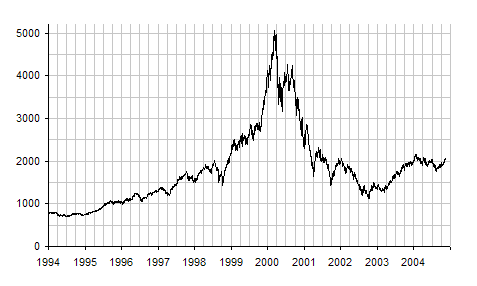
The Dot-Com bubble. Artificial inflation of high-tech stock prices (Alan Greenspan's "irrational exuberance") added trillions of dollars to the stock market during the Clinton administration. When the bubble burst, it wiped $4 trillion off the market. The September 11 attack sank the market by another trillion. How President Bush can be held responsible for either of these is frankly beyond me, but then, I'm not a Historian.
Taken, in the wake of the terrorist attacks two years ago, the greatest worldwide outpouring of goodwill the United States has enjoyed at least since World War II
Which lasted all of what, five minutes?
and squandered it by insisting on pursuing a foolish go-it-almost-alone invasion of Iraq
I love that phrase, "a foolish go-it-almost-alone invasion".
thereby transforming almost universal support for the United States into worldwide condemnation.
The coalition of the unbribed freed the people Iraq from a murderous thug and gave them a chance for self-determination. That matters to me, but then, I'm not a Historian.
Misled (to use the most charitable word and interpretation)
Most charitable?
the American public about weapons of mass destruction and supposed ties to Al Qaeda in Iraq
Cite.
and so into a war that has plainly (and entirely predictably) made us less secure
How has it made us less secure, exactly?
I'm waiting.
caused a boom in the recruitment of terrorists
Who were previously known as
the government.is killing American military personnel needlessly
Twenty-five million Iraqis beg to differ, but then, they are not Historians.
and is threatening to suck up all our available military forces and be a bottomless pit for the money of American taxpayers for years to come.
Well, America could bring home the troops currently stationed in Europe and South Korea, where they are apparently not wanted. I mean, they've been there for
years.
And you know, Iraq might not be sucking up all available military forces if President Clinton hadn't gutted them in the first place. This thought occured to me, but then I'm not a Historian.
Failed to follow through in Afghanistan, where the Taliban and Al Qaeda are regrouping, once more increasing the threat to our people.
Hey, there is a certain small kernel of validity to this one! We are still in Afghanistan, still fighting the Taliban, most certainly still hunting down and eliminating Al Qaeda, but we could be doing more to aid the reconstruction there.
Insulted and ridiculed other nations and international organizations and now has to go, hat in hand, to those nations and organizations begging for their assistance.
Eh?
You wouldn't care to produce an example of this, by any chance? I like to see specifics rather than sweeping claims, but then, I'm not a Historian.
Completely miscalculated or failed to plan for the personnel and monetary needs in Iraq after the war
It's a war, bucko. You don't know how a war is going to go until it's gone, because you have an
enemy who is trying to
stop you.
so that he sought and obtained an $87 billion appropriation for Iraq, a sizable chunk of which is going, without competitive bidding to Haliburton, the company formerly headed by his vice president.
Halliburton!
Now, I know the reasons and origins of the Halliburton contract - which dates to the Clinton administration - and would never resort to misleading my audience that way. But then, I'm not a Historian.
Inherited an annual federal budget surplus of $230 billion and transformed it into a $500+ billion deficit in less than three years. This negative turnaround of three-quarters of a trillion dollars is totally without precedent in our history. The ballooning deficit for fiscal 2004 is rapidly approaching twice the dollar size of the previous record deficit, $290 billion, set in 1992, the last year of the administration of President Bush’s father and, at almost 5 percent of GDP, is closing in on the percentage record set by Ronald Reagan in 1986.
Another kernel of validity. There are good reasons for the deficit, but the budget does need to be cut to bring it into line with the tax cuts. Me, I'd start with farm subsidies.
Whack. Cut taxes three times, sharply reducing the burden on the rich
Again, the claim that the tax cuts only benefited the rich.
reclassified money obtained through stock ownership as more deserving than money earned through work.
Is there any reason why capital gains should be taxed at the same rate as other income? Because the nature of capital gains is completely different to, for example, a Historian's salary.
Severely curtailed the very American freedoms that our military people are supposed to be fighting to defend.
Exactly what are these freedoms that the Patriot Act has curtailed?
Called upon American armed service people, including Reserve forces, to sacrifice for ever-lengthening tours of duty in a hostile and dangerous environment while he rewards the rich at home with lower taxes and legislative giveaways and gives lucrative no-bid contracts to American corporations linked with the administration.
First, if you are in the armed service, including the Reserve and the National Guard, you are there to serve. It's not a free-education and world-tour club.
Second, we freed fifty million people from tyranny. When did that last happen without sacrifice, Mr Historian?
Third, your points on taxes and Halliburton have already been made and refuted. You don't get to run them up the field again.
Given an opportunity to begin to change the consumption-oriented values of the nation after September 11, 2001, when people were prepared to make a sacrifice for the common good, called instead of Americans to ‘sacrifice’ by going out and buying things.
The values of the nation are the values of the
nation, not the values of the President, or the values of a Historian. And America, like it or not, was founded and has thrived for nearly two hundred and thirty years on capitalism, on your "consumption-oriented values".
Proclaimed himself to be a conservative while maintaining that big government should be able to run roughshod over the Bill of Rights
Which has not happened.
and that the government must have all sorts of secrets from the people
As has every government in history, something one might expect a Historian to know.
but the people can be allowed no privacy from the government.
Eh? What privacy of yours has been infringed, Mr Historian?
And here's McElvaine's parting gift:
Some voters may judge such assessments to be wrong, but they are assessments informed by historical knowledge and the electorate ought to have them available to take into consideration during this election year.
Informed by historical knowledge? That certainly doesn't show.
But they are most certainly untroubled by any knowledge of economics or the conduct of war, by any care for human rights, or any concern for hewing to the truth.
An F for you, Mr McElvaine. A B+ for President Bush.
(Via Instapundit)
Posted by: Pixy Misa at
10:30 PM
| Comments (3)
| Add Comment
| Trackbacks (Suck)
Post contains 1465 words, total size 10 kb.
1
I am always delighted to learn that I am considered "the rich"--but then, I suspect everyone in America, even the poorest, are rich when compared to many other nations. There are probably a few families in the hills of Appalachia that have outdoor plumbing, but I bet they are
still better off than a lot of the world...
Posted by: Susie at Friday, May 27 2005 11:10 AM (V1YvO)
2
Another classic fisking. Thanks for sharing.
Posted by: TallDave at Friday, May 27 2005 03:32 PM (9XE6n)
3
Enjoyable read. I thank the Physics Geek for directing me here. Into my favorites folder you go...
Posted by: skh at Saturday, May 28 2005 09:15 PM (c0W4c)
Hide Comments
| Add Comment
Why Do They Hate Us?
Editor and Publisher
asks the question. But they're not so sure what to do with the answers.
As in most previous surveys of journalists, a high number called themselves politically "moderate" (49%), with 31% describing themselves as "liberal" and just 9% as "conservative."
Even if those labels were accurate, that's massively skewed compared to the public. What one might ask is, how many of those self-described moderates voted Democrat, and how many Republican? As Hugh Hewitt found, they are strangely reluctant to answer.
Forty-eight percent of the public but only 11% of journalists said news organizations were "often inaccurate." When serious mistakes are made, 74% of the journalists said news organizations quickly report the error, but only 30% of the public said they do. In the public, 24% said news organizations try to ignore errors and 41% said they try to cover them up.
"That was the most surprising thing, the public perception that journalists don't correct errors," Kathleen Hall Jamieson, director of the Annenberg Center, told E&P. "We focused on the serious errors and you have journalists believing they correct them. You'd like to know what the truth is."
Yes, we'd like to know what the truth is. But we don't trust you to tell us. Two-thirds of the public thinks that news organizations ignore or cover-up their errors; three-quarters of journalists believe that their errors are quickly corrected.
That's not a gap, that's a chasm. A yawning gulf:
"This study reveals a worrisome divide between the public's view of journalism and journalists' own views of their work," Geneva Overholser, a former Washington Post ombudsman and the author of a new book on the press, said in a statement. "If journalists do indeed believe that what they do is valuable, fair, and ethically sound, it's past time they began to put that case more effectively to the public."
In other words, if the public think we are worthless, unfair and unethical, they just need to be
educated. Shame about those circulation figures...
(Via Roger L. Simon)
Posted by: Pixy Misa at
10:02 PM
| Comments (3)
| Add Comment
| Trackbacks (Suck)
Post contains 341 words, total size 2 kb.
1
If people would just do what their moral/intellectual superiors at newspapers and universities tell them to do, everything would be fine.
Instead, you people have to ruin everything with all that thinking for yourself. Shame on you.
Posted by: TallDave at Thursday, May 26 2005 11:40 PM (H8Wgl)
2
Speaking of universities, I just had a whack at them as well. :)
Posted by: Pixy Misa at Friday, May 27 2005 12:13 AM (AIaDY)
3
ya pidoras, pizu chujie doors, zaabuzte moi url - http://greatpharmacies.com/ a suda pishite pisma i spamte - admass@pisem.net
Posted by: ya pidoras at Wednesday, July 26 2006 12:52 AM (XGpjK)
Hide Comments
| Add Comment
189kb generated in CPU 0.0622, elapsed 0.2226 seconds.
59 queries taking 0.1919 seconds, 291 records returned.
Powered by Minx 1.1.6c-pink.